Whatever you studied, whatever your qualifications are, isn’t getting you anywhere without cracking an interview. Though the idea of presenting yourself in 30 minutes doesn’t uncover your full potential and gets you judged on whether you are worth hiring, it is still a skill to brief out about yourself and be confident enough to do so as well. Knowing and answering relevant questions is also important to show how much you have prepared yourself. What you know isn’t relevant unless it is expected of you in the role or asked of you in a specific interview. Preparing for these questions is a great way to showcase your knowledge and get hired. Here are the most common MERN stack interview questions for you to prepare for your next interview.
What is MERN Stack?
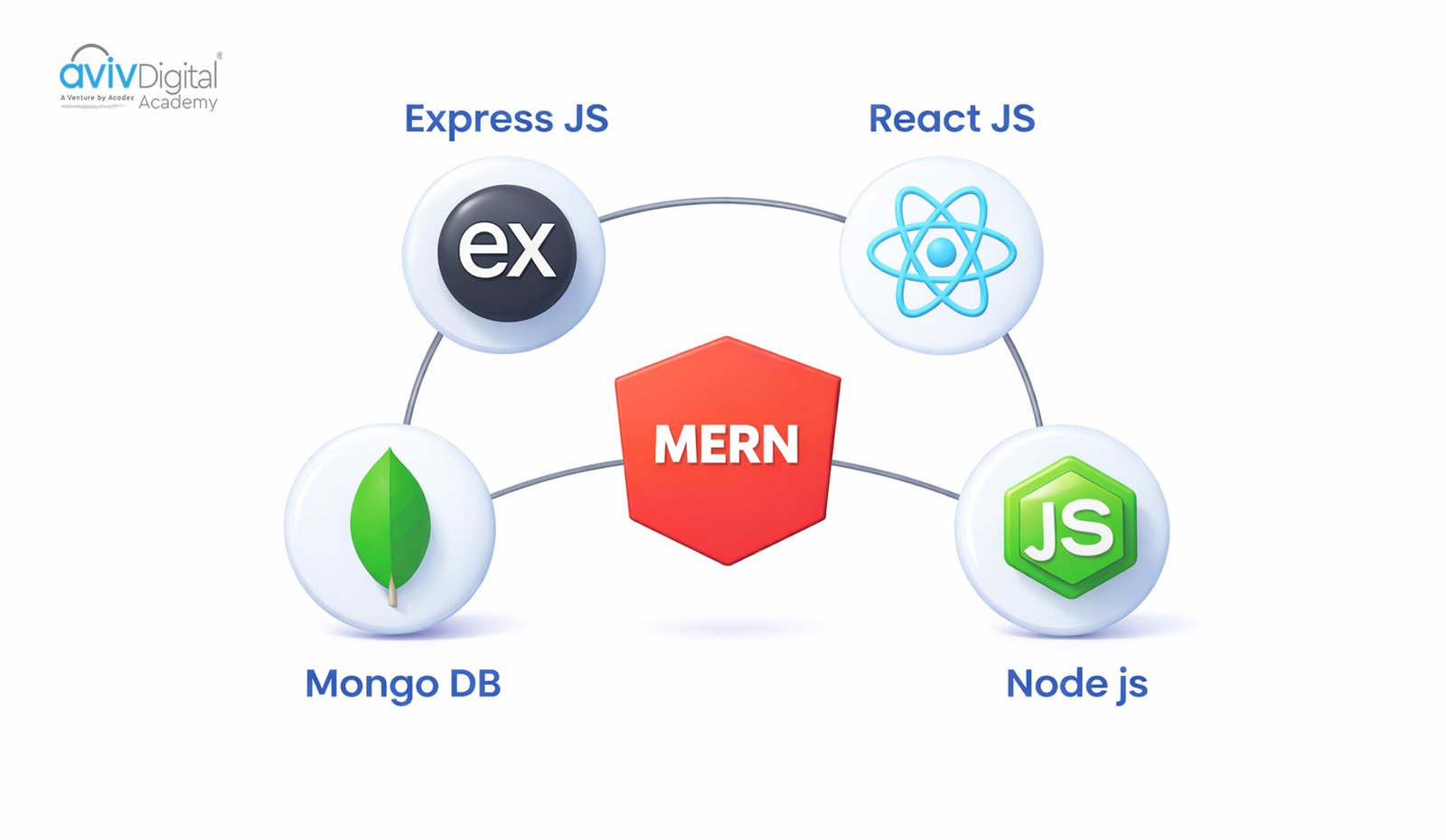
Understanding what the MERN Stack is may be the most important step, even before preparing for interviews. “What is MERN Stack?” is also one of the most common MERN Stack interview questions. The MERN stack is a JavaScript-based solution for building powerful and dynamic web applications. It gets its name from the four technologies it uses: MongoDB, Express.js, React, and Node.js, all of which work together using a single language: JavaScript. Today, the MERN stack powers over 30 million websites globally, and Node.js holds a 4.5% market share in 2025, up from 3.1% the previous year, showing how rapidly this ecosystem is growing. In fact, there are 1,469 MERN stack developer jobs posted on Naukri in 2025, making it a highly in-demand skill set. Let’s explore these technologies in detail so you can confidently answer MERN stack interview questions.
What is MongoDB?
In simple terms, MongoDB is a NoSQL document database that stores data in documents like JSON. Its use case includes Dynamic Schema, horizontal scaling and real-time analysis. Key features are BSON storage, built-in replication and sharding.
What is Express.js?
Express.js is a framework extensively used by Nord.js. It handles HTTP requests and middleware. The use cases of Express.js involve building RESTful APIs, routing and middleware pipelines. Its key features are its lightweight, extensibility, and middleware modules
What is React?
React is a component-based library tailored for front-end development to create interactive UI’s. Single-page application (SPA) and dynamic client-side rendering are one of its major use cases. It comes with key features such as Virtual DOM, reusable components, hooks for state and side effects.
What is Node.js?
Node.js is a JavaScript run-time that is created on Chrome’s V8 engine, running server-side code. Common use cases of Node.js are non-blocking, event-driven servers for applications that run in real-time. Packaged eco-system via npm, event loop for high concurrency are its key features.
Hope these have polished your information on MERN stack. Expect these common questions on MERN stack interviews as well. Let’s take a look at the other common MERN stack interview questions.
Why Use MERN?
This question could be the most asked in a MERN stack interview. Why use MERN would let you answer what you know about it, its relevance and why MERN is a better alternative for many. You can learn and answer these in your own style, tone or variation.
- Having JavaScript across the whole stack and no context-switching between languages makes MERN a great choice.
- With thousands of npm packages and React libraries, MERN possesses a rich ecosystem.
- The MongoDB documents and Express/Node APIs come with a JSON and React client with horizontal scaling via Node Clusters and MongoDB sharding
- Another reason to use MERN is its strong community and resources, such as its support, tutorials and boilerplates.
Additionally, with the demand for full-stack developers projected to rise by 20% in the coming years, MERN becomes even more valuable as it equips developers with both front-end and back-end expertise.
Typical MERN Architecture
Another common MERN interview question is the typical MERN architecture, you may have to answer regarding the client, server, Database and its build and deployment in detail. You can learn and answer from the resource below.
- The client is React, which renders UI components and manages client-side routing with the React Router. It also communicates with the server via fetch/axios
- Express and Node make the server with it, defining RESTful endpoints and implementing business logic. The server also handles authentication, validation and error handling.
- MongoDB makes up the database of MERN and is responsible for storing user data, application state, product catalogues and much more. The database is managed via a MongoDB driver or ODM such as Mongoose.
- Build and deployment uses Webpack/Vite build for React, PM2 or Docker for Node processes and CI/CD pipelines like GitHub Actions and Jenkins.
After you have understood these well take note of the short and simple MERN stack interview questions, with answers to help you out.
MERN Stack Interview Questions
MongoDB Interview Questions and Answers
1. Why Choose MongoDB over a Relational Database?
Choosing MongoDB over a relational database offers schema flexibility, allowing documents to evolve without complex migrations. MongoDB also supports horizontal scaling through native sharding, which makes it ideal for large datasets. Its JSON-like document structure fits naturally with JavaScript-based frameworks like Node.js and React. This is why document databases like MongoDB are leading the NoSQL boom, as the NoSQL market is projected to grow at a CAGR of 28–30% through 2032–2034, with document-based systems seeing the fastest adoption.
2. Can you Describe How to Model Relationships in MongoDB?
There are three ways to model relationships in MongoDB: embedding, referencing and using Mongoose’s “populate()” to join on queries. Embedding sub-documents for one-to-few relationships and referencing by storeobjectid references, such as one-to-many or many-to-many.
3. What is Replication in MongoDB?
Replication in MongoDB creates numerous copies of the data among different servers named replica sets. The replication process enhances the read capacity by enabling clients to distribute read operations across these replica sets. They are responsible for storing data copies across numerous data centres, improving data localisation and availability for distributed applications. In addition to that, replication maintains surplus copies serving specific purposes like backup, reporting and disaster recovery.
4. What is BSON, and why does MongoDB use it?
BSON is just Binary JSON, and being in a MERN stack developer interview, you may be asked these MERN stack developer interview questions. MongoDB uses BSON for storage and transmission due to its efficiency compared to JSON
5. How does MonoDB Handle Schema Design for a Large-Scale Application?
Flexible schemas are supported by MongoDB, which are optimised based on performance
- They use embedded documents to Nest related data in a single document for quick reading.
- It uses references requiring frequent updation or huge amounts of data.
To scale MongoDB, make use of the sharding process that distributes data among multiple servers
6. What is Sharding in MongoDB?
Data sharding consists of horizontal partitioning of a database across several systems and makes it possible to process a large amount of data and have high throughput. From an architectural perspective, sharding is accomplished by using a shard key to partition the data between the different systems (shards) and distribute it among those systems (shards).
7. What is Replication in MongoDB?
MongoDB uses replication to keep several copies of the same information stored across many different database servers to create a dependable service with little or no downtime. This technique of using a “replica set” consists of a single “primary” server that receives all write requests, and a group of “secondary” servers that continuously replicate the data stored in the primary server. When there is a failure of the primary server, the secondary server immediately assumes control, resulting in very little to no downtime. In addition to providing high availability, replication provides the ability to back up the data and recover from major data losses. Replica sets also increase the number of servers that can serve reads from a single piece of data.
8. What is Aggregation in MongoDB?
Aggregating Data with MongoDB is a way of organising data using a machine-learning process to derive meaningful insights from it. The MongoDB aggregation pipeline follows this process by taking documents and passing them through different stages of analysis, such as filtration, grouping, ordering, and computing. Aggregation allows for similar analysis and functions as SQL’s GROUP BY, or with Data Analytics capabilities, directly at the database level. Aggregation is widely used in the preparation of large datasets for reporting, summarisation, and analytical purposes.
9. What are Collections and Documents in MongoDB?
A document is the basic unit of data in MongoDB, stored in BSON(Binary JSON) format, using field-value pairs. Every document contains a unique _id, which acts as its primary key. A document can include nested objects and arrays, and it helps to store complex data naturally.
A collection is a group of documents which are related to each other and are stored together in a database. Documents inside a collection can have different structures.
10. What are Common MongoDB Operators?
Commonly, MongoDB operators are :
Comparison : $eq, $ne, $gt, $gte, $lt, $lte, $in
Logical : $and, $or, $nor, $not
Evaluation : $regex, $text, $where
Update : $set, $unset, $push, $pull
Arrays : $addToset, $pop
MongoDB’s massive adoption is also driven by its developer ecosystem. It now has over 2 million registered developers, 35,000+ GitHub stars, and more than 500 core contributors, which creates a strong network effect that keeps the platform improving rapidly and staying relevant in modern application development.
Express.js Interview Questions and Answers
1. What Role does Express.js play?
The answer to this is simple: the role of Express.js assists in routing maps, HTTP methods, as well as URLs to handlers. It also serves as a middleware for pre- and post-processors for requests such as logging, auth and so on. Additionally, Express.js manages error handling and centralises error response and logging.
2. What is Middleware in Express?
A middleware in MERN is a function with a signature (req, res, next) that can modify req/res, end the request and send a response, as well as call next() in order to pass or control to the next middleware.
3. What is CORS, and why do you need it in the MERN stack?
Cross-Origin-Resources, also called CORS, is a security feature that is integrated by browsers to restrict different domains in a MERN stack application. Node.js and Express.js from the backend side and React from the front-end side tend to run on different domains or ports, and this triggers the CORS from the middleware.
Use this JavaScript to enable CORS in Express.js with the cors middleware
const cors = require(‘cors’);
app.use(cors());
4. How Do You Handle Errors in Express.js?
Errors in Express.js are handled using middleware functions. To catch and respond to errors consistently, create an error-handling middleware function using four parameters (err, req, res, next). Using try-catch blocks in async routes and calling next(err) helps pass errors to middleware for response handling.
5. Why Use Express.js Over Vanilla Node.js?
Express.js is preferred to Node.js because it provides a structured and light-hearted framework that can make building web servers and APIs simpler.
Benefits of Express.js over Node.js :
- The routing system is built in and easy to implement
- Middleware such as authentication, logging and validation are all easy to support
- An error handler that is easier to use
- APIs can be developed and maintained more quickly using Express.js, making it easier for a company to scale API growth.
- Code is less verbose than pure Node.js
6. What are RESTful Routes?
Restful routes are standardised URL patterns designed based on REST (Representational State Transfer) principles. RESTful routing implies using standard HTTP methods and URLs to perform CRUD(Create, Read, Update, Delete) operations. Restful routes help React to communicate with Express and Node.js in a MERN stack application, also it makes it easier to understand APIs, easier to maintain and easier for frontend and backend to work together. Some of the common RESTful routes are :
| HTTP Method | Route | Purpose |
| GET | /resource | Retrieves all resources |
| POST | /resource | Create new |
| PUT | /resource/:id | Update |
| PATCH | /resource/:id | Partially update |
| DELETE | /resource/:id | Delete the resource |
7. What is the Difference Between app.use and app.get?
app.use() – used for middleware authentication and logging, and works with all HTTP methods like GET, POST, PUT and DELETE.
app.get() – used to send data and render responses, and works only with GET requests.
8. How Do You Implement Authentication?
Authentication is done using JWT(JSON Web Tokens). User logs in with valid credentials, the server verifies them and issues a token. This token, which is stored with the user, is sent with each request, and after validation, access is granted.
9. How Do You Parse Request Bodies?
Request bodies are parsed using built-in middleware like express.json() and express.urlencoded(). These read incoming requests and convert them into JavaScript objects, making it easier to access form data and JSON payloads.
10. What is Next() in Express.js?
next() is a function in middleware used to pass control to the next middleware in the request-response cycle. It makes multiple middleware functions run in sequence and helps to manage tasks like authentication, logging, and error handling.
React.js Interview Questions and Answers

1. How do you Manage State in React?
The states in React are divided into Local state, global state and server state. For managing the Local state, use “useState” or “useReducer” for the component-level state. For the Global state, use Context API or external libraries (Redux, Zustand, MobX), and finally, for Server state, Data fetching from libraries like React, Query and SWR would be ideal.
2. How do you optimise React performance
That’s a great question! You may say this as it showcases your confidence and expertise in the MERN stack in a MERN stack interview. The simple answer to this question is: Monetisation using React. memo, useMemo, use Callback and Code Splitting with import() and React. lazy. You can avoid unnecessary renders, such as Key prop, immaculate data and pure components
3. What is React.js and Its Key Features?
React.js is an open-source JavaScript library used to build fast and interactive user interfaces. It is one of the most widely adopted frontend libraries in the world. React leads NPM downloads with over 15 million weekly downloads compared to Angular’s 2.5 million and has accumulated around 223,000 GitHub stars, showing its massive developer trust and ecosystem.
- Component-based architecture
- JavaScript XML
- Unidirectional data flow
- Virtual DOM
- Support for hooks
- Reusable UI components
4. What is JSX?
JavaScript XML (JSX) is a React-specific extension for the JavaScript language, which enables developers to write markup code similar to HTML markup. Because JSX allows developers to write more human-readable code when creating user interfaces, when compiling an application built using React, JSX is automatically converted into JavaScript.
5. What are React hooks?
Developers use React Hooks to create state and other features using the functional component. They simplify the Component Logic by removing the need for using Class Components. Thus, React makes it easier for developers to write cleanly organised source code.
Commonly used hooks in React.js are :
- useState: Manages local state
- useEffect: Handles side effects like data fetching and subscriptions
- useContext: Access global data
- useRef: Accesses DOM elements and stores mutable values
- useReducer: Manages complex state logic
- useMemo/useCallback: Memoises functions and values
6. What is Virtual DOM?
React uses a Virtual DOM, which is a small copy of the actual DOM to enhance the system’s performance level due to the fact that when an application state is changed, the Virtual DOM is updated as well. After updating the Virtual DOM, it is compared against the prior version of that DOM and only the differences are reflected in the actual back-end DOM. This enables faster and more efficient performance in UI modification.
7. What are Functional and Class Components?
Functional components are written as JavaScript functions returning JSX (JavaScript XML). Using hooks has allowed functional components to replace class-based components as the standard method for building components with access to state and lifecycle features.
8. What is the UseEffect Hook?
The React hook “useEffect” allows functional components to perform side effects, like fetching data, modifying the DOM, and creating subscriptions. The hook runs after the React component renders and can be re-run at the discretion of the developer based on the dependencies provided in the dependency array supplied by the developer.
9. What is Redux and its Components?
Redux is a standard state management library used in React applications to manage and share application state for large and complex apps.
Major components of Redux include :
- Store – where all the app’s data is stored
- Actions – Messages that tell Redux what happened
- Reducers – Decides how the data would change
- Dispatch – Sends action to the store
- Selectors – Retrieve specific data from the store
10. How do you Optimise React performance?
By reducing unnecessary re-renders and loading only the necessary, React performance can be optimised. Common techniques for optimising React performance are React. memo, useMemo, useCallback, lazy loading through React.lazy() for code splitting, and ensuring state remains as simple as possible and structured correctly.
Node.js Interview Questions and Answers
1. Describe the Node.js event loop
The Node.js event loop is a single-threaded loop that handles asynchronous callbacks. It works through multiple phases, such as timers, I/O callbacks, idle/prepare, poll, check, and close callbacks, allowing Node.js to handle many operations efficiently without blocking. This architecture is a major reason why Node.js scales so well. It has been downloaded more than 147.5 million times since 2014 and now receives around 130 million downloads every month, reflecting about 40% year-over-year growth.
2. What is NPM?
NPM (Node Package Manager) is a tool used with Node.js to install, manage and share JavaScript libraries.
3. What is EventEmitter?
EventEmitter is a Node.js feature that helps different parts of an application communicate with each other. While one part of the program sends an event, the other part listens and runs code in response.
4. What is Package.json?
Package.json is a project file in Node.js. It stores details of a project, such as project name, version, dependencies, and scripts required to run the application.
5. What is the Fs Module?
Fs (file system) module is a built-in module in Node.js for file operations. It helps to read, write, update and delete files on your system using JavaScript.
6. What is the difference between require and import?
| Feature | require | import |
| Module System | CommonJS | ES Modules |
| Usage | Node.js | Modern JavaScript and React |
| Placement | Anywhere in the file | Top of the file |
| Loading | Runtime | Compile time |
7. How do you Handle Asynchronous Operations?
In both JavaScript and Node.js, asynchronous operations can be managed by Callbacks, promises, and Async/Await. However, using Async/Await, you can write simple, non-blocking asynchronous JavaScript code that is much easier to read, maintain and debug than either call-out or Promise.
8. How do you Handle Errors in Node.js?
Errors are handled using try-catch blocks, error-first callbacks and promise error handling in Node.js. A centralised error handling ensures that errors are logged and responded to properly without crashing the application.
9. What is a Buffer in Node.js?
A buffer in Node.js is a temporary storage for binary data. It helps Node.js to handle binary data efficiently when working with streams or files.
10. What are Streams in Node.js?
Streams in Node.js help you to read or write data piece by piece instead of loading everything at once. It helps to work with large and complex files or data over the network faster and efficiently. Different types of streams are :
Transform – Modify data while reading or writing.
Readable – Read data from a source
Writable – Write data to a destination
Duplex – Can read and write data
General MERN Stack Interview Questions

1. Explain JWT Authentication Flow
These are amongst the most commonly asked questions in a MERN stack interview. You can answer by explaining JWT authentication and then the flow. Start answering by saying, This is a commonly used authentication mechanism in modern web applications. They work by securely transmitting information between a client and a server in the form of a compact JSON object. JWTs are often used for stateless authentication, where the server does not need to keep a record of the user’s session. The flow is as follows:
- The user logs in, and the server is verified
- Then the server issues a signed certificate containing the user’s claims
- Next in the flow, the client stores a token, such as a cookie or localStorage
- It’s followed by subsequent requests, including a token in the authorisation header
- The server then verifies the token signature, extracting the user info
2. What is Mongoose, and why use it?
Understanding this is essential in MERN. Mongoose is an Object Data Modelling (ODM) library for MongoDB and Node.js. It is useful for providing schema definitions and data validation. Mongoose also offers middleware hooks, like before/after save, as well as update. The prominent use of Mongoose, and if asked why to use it, must be answered by its ability to simplify queries and relationships.
3. How would you deploy a MERN app?
MERN stack interview questions can be hard at times, but knowing plenty wouldn’t help if you can’t answer them the right way. Being able to answer in a good flow is crucial as well. To answer this MERN Stack interview question, do it step by step:
- Back end: Dockerize Node app by pushing to AWS, ECS/EKS, Heroku or DigitalOcean
- Database: with a database like MongoDB Atlas or a managed Mongo service.
- Front end: build React bundle and serve via CDN or static hosting using tools like Netlify, Vercel
- Finally, to deploy a MERN app, use CI/CD to automate builds and tests using GitHub, Actions or Jenkins.
4. Explain the MVC Architecture.
MVC stands for Model-View-Controller, and it is a framework. MVC deals with organising code for web applications. Add this to your answer that MVC architecture separates the application into three parts, as suggested by the name, with each of them having a specific role.
- The model stores and manages data
- Then represents the data in a way that is seamless for the application to understand.
5. Describe RESTful API and how it is Relevant in the MERN stack?
Simple answer if you are asked these MERN stack interview questions, remind yourself to stress less and answer them in the best way possible. A RESTful API is a set of guidelines utilised for creating and communicating with services online. Back-end servers developed via Node.js and Express.js usually send and receive data using RESTful API’s that consist of MERN. Interacting with front-end React applications is possible for developers
6. What is the Difference Between SQL and NoSQL Databases?
This is among the most important MERN stack interview questions since it plays a huge part in MERN stack development. SQL databases are relational, storing data in tables with schemas that are established schemas. Mean while unstructured data is saved by NoSQL databases such as MongoDB. NoSQL database saves this data in formats like JSON. To add on, showcasing your expertise, you can also mention that NoSQL databases enable scalability and adaptability, optimal for MERN stack applications.
7. Compare MERN with MEAN stack
When it comes to two of the most popular development stacks, MERN and MEAN are both significant and come with their own purpose. MERN utilises React for the front end, and MEAN uses Angular. The key difference is that React is flexible, while Angular is a strictly structured framework that comes with pre-built features. In simple terms, MERN offers freedom, and MEAN comes with a featured approach.
8. What does Asynchronous API mean in the MERN Stack?
In the context of MERN stack development, interview questions, developers are asked these questions frequently. The simple answer is that handling asynchronous operations cannot be avoided. clarifying its concepts and how they contribute to non-blocking operations is essential.
- It supports additional types of data
- It does parsing faster in a smaller size due to the binary format.
9. How do you optimise a MERN Application?
This is a general question asked in a MERN stack developer interview. SImple answer to this question is using lazy loading, a caching process and efficient queries.
10. How Do MERN Stack Components Interact?
In the MERN stack, MongoDB stores data, Express handles the user interface, React and Node.js process requests and business logic. MERN stack components interact through APIs. React sends API requests to the backend, the server fetches data from MongoDB and updates it, and finally response is sent back to React to update the user interface.
Conclusion
To conclude, preparing for the above-mentioned MERN interview questions would put you in an advantageous position. Though doing research is also significant, these are the most common questions, but you should realise there are more and predict what might be difficult. Additionally, be confident, have a great portfolio, and be prepared to work on some live projects to showcase your skills
Aviv Digital Academy is one of the leading institutes that provides a Full Stack Development Course in Kochi. We offer a comprehensive curriculum designed to equip you with the skills and knowledge necessary to thrive in the industry. For more details, contact us at: +91 8156998844
Frequently Asked Questions
What types of live coding tasks are common in MERN stack interviews?
Expect a small full-stack piece (React + Express) or algorithmic JavaScript task, and be ready to explain your thought process.
How do I prepare for my “CTO round” interview for a MERN developer role?
Expect higher-level questions about architecture, system design (client/server/data flow), scalability, maybe team-fit and communication; be ready to discuss your project end-to-end.
Where can I find good resources to practice MERN stack interview questions?
Use resources specialising in full-stack JavaScript, MERN guided Q&A, GitHub repos, live coding platforms, and also review your own built projects.