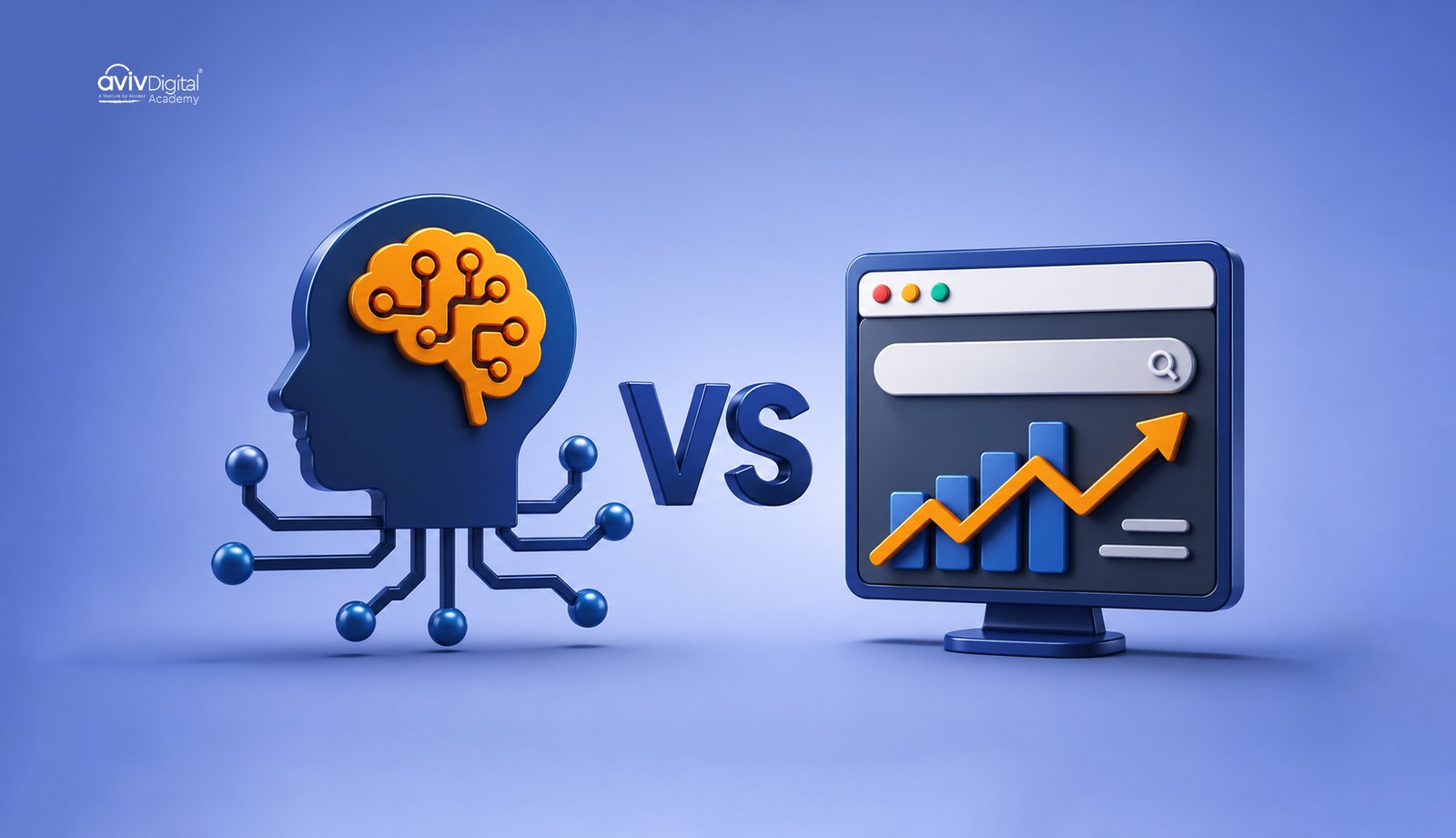
The digital landscape is shifting rapidly, and search engine optimization sits right at the center of that shift. For nearly three decades, marketers have relied on traditional SEO, methodical keyword research, patient link building, and careful technical optimization. Those tactics worked then, and many still work today. But 2026 is a genuine inflection point. Generative AI is changing how people search and how search engines respond, forcing a real question: is AI SEO replacing traditional SEO, or do the two need to work together? Based on what’s actually happening in search results right now, the honest answer is “together.” This guide compares both approaches honestly, then helps you figure out which one, or what combination, actually matters more for your business in 2026.
What Is Traditional SEO?
Traditional SEO has been the backbone of organic search marketing since Google’s earliest days. When most people say “SEO,” they’re usually describing traditional SEO, the established, proven tactics search engines have consistently rewarded for nearly three decades.
Keyword Research & Optimization
The foundation of traditional SEO is keyword research: identifying the terms your audience actually searches for, then optimizing content to rank for them. This means placing keywords naturally in strategic locations, page titles and meta descriptions, headings, body content, and internal link anchor text. The real challenge isn’t finding keywords; it’s finding the right ones, terms with enough search volume to matter but manageable enough competition that you can realistically rank.
On-Page Optimization
- Compelling H1 tags and meta descriptions that match search intent and encourage clicks
- A clean heading hierarchy (H1 → H2 → H3) that helps both search engines and readers follow the page
- Descriptive image alt text that includes relevant keywords
- Page speed optimization: Core Web Vitals remain a ranking factor, and fast pages rank better
Mobile responsiveness matters too; more than 60% of searches now happen on mobile devices, so confirm the current figure before publishing.
Link Building
Backlinks remain a meaningful ranking factor; links act as votes of confidence from other sites. Traditional tactics include guest posting on authoritative industry sites, broken-link building, relevant directory submissions, resource-page outreach, and responding to journalist source requests through platforms like Connectively (formerly HARO). The best links still come naturally, from sites that genuinely want to reference your content.
Technical SEO
Technical SEO makes sure search engines can crawl, understand, and index a site effectively: XML sitemaps, a well-configured robots.txt file, schema.org structured data, fixing crawl errors (404s, redirects, and server errors), and running on HTTPS.
Content Marketing
Long-form, genuinely useful content remains a cornerstone: comprehensive blog posts, step-by-step guides, case studies, and original research that demonstrates real expertise.
Strengths of Traditional SEO
- Proven track record: These methods have consistently delivered results for over 20 years. We have two decades of data proving they work.
- Full control: You directly manage your optimization efforts. No algorithm dependency or tool limitations.
- Transparent metrics: Google Analytics clearly shows which tactics drive traffic and revenue.
- Cost-effective for small businesses: Many tactics require only time and effort, not significant investment. You can rank without paying for expensive AI tools.
- Sustainability: Rankings gained through quality content tend to be more stable and long-lasting.
Limitations of Traditional SEO
- Time-intensive: Results can take 3-6 months to materialize. Patience is required before seeing ROI.
- Scale challenges: Manual optimization doesn’t scale well to hundreds or thousands of pages. You hit a ceiling on what one team can manage.
- Static approach: Traditional methods can’t adapt quickly to search behavior shifts or algorithm updates.
- Creativity bottlenecks: Heavy reliance on manual research limits how innovative you can be.
- Requires expertise: SEO knowledge isn’t intuitive. It takes time and experience to do well.
What Is AI SEO?
AI SEO is the use of artificial intelligence, machine learning, and natural language processing inside SEO strategy. This isn’t about AI replacing SEO professionals; it’s about AI augmenting and accelerating what a team can already do. Traditional SEO is like manually optimizing one website; AI SEO is closer to having a team of analysts working across hundreds of pages at once.
Intelligent Keyword Research

AI tools analyze search behavior at scale, not just what people search for, but why. They can spot semantic relationships between keywords, cluster terms by intent (informational, commercial, and transactional), and surface long-tail variations a manual process would likely miss.
For example, keyword research might turn up two options: a broad, high-volume term like “project management software,” versus a longer, more specific phrase like “best project management tool for freelancers.” In practice, the narrower phrase often converts noticeably better, because it matches exactly what that searcher is trying to solve, even though the volume looks unimpressive on paper. This is the kind of pattern AI-assisted keyword tools are good at surfacing at scale.
Content Generation & Optimization
AI writing assistants can generate outlines based on top-ranking competitors, draft sections with natural keyword incorporation, flag issues like keyword stuffing or thin content, and test multiple content angles quickly. Importantly, AI-generated content still needs human review and editing; the best results come from AI-assisted writing, not AI-only writing.
Predictive Analytics & Personalization
Machine learning models can forecast which content is likely to rank based on competitor and backlink analysis, suggest optimal publishing cadence, and support content personalization, dynamic meta tags, tailored recommendations, and layouts that adapt to user behavior.
Technical SEO Automation & Link Intelligence
AI can flag technical issues across thousands of pages at once, help prioritize crawl budget, generate schema markup automatically, and identify realistic link-building prospects by relevance and authority, reducing a lot of manual prospecting work.
Strengths of AI SEO
- Speed: Delivers insights and optimizations in days, not months. Time-to-value is dramatically reduced.
- Scalability: Handles optimization across entire websites automatically. Enterprise-scale SEO becomes feasible.
- Adaptability: Learns from search behavior and adjusts strategies in real-time as trends shift.
- Efficiency: Automates repetitive tasks, freeing your team to focus on strategy and creativity.
- Innovation: Identifies optimization opportunities humans might miss through pattern analysis.
- Data processing: Analyzes competitive landscapes and market opportunities at scale no human team could match.
Limitations of AI SEO
- Requires training & expertise: Setting up AI tools effectively requires knowledge. You can’t just enable a tool and forget it.
- Significant initial investment: Quality AI tools require substantial financial commitment ($1,000-10,000+ monthly).
- Quality control needed: AI-generated content still requires human review and editing.
- Over-optimization risk: Aggressive automation can lead to keyword stuffing or unnatural content if not monitored.
- Privacy concerns: Data collection and personalization raise compliance issues (GDPR, CCPA, etc.).
- Tool dependency: Your rankings partly depend on third-party AI tools that can change or fail.
AI SEO vs. Traditional SEO: Head-to-Head Comparison
Here’s how the two approaches actually compare across the tasks that matter day to day:
| Aspect | Traditional SEO | AI SEO |
| Implementation speed | 3–6 months to see measurable results | Initial insights within 2–4 weeks; measurable ranking movement usually follows by weeks 6–8 |
| Scalability | Limited; manual work becomes difficult to scale. | Strong, automates repetitive SEO tasks across large sites |
| Cost | Lower tool cost, higher ongoing manual effort | Higher tool investment, lower ongoing labor cost |
| Content quality | Primarily human-written, often stronger editorial depth | AI-assisted drafting that benefits from human review and refinement |
| Adaptability | Slower, updates require manual intervention. | Faster, can adapt to algorithm and trend shifts quickly |
| ROI timeline | Long-term strategy, typically 6–12 months or longer | Early signals appear fast, but full ROI still plays out over a similar multi-month horizon as adoption matures. |
| Learning curve | Moderate, established best practices, abundant resources | Steeper, tools and workflows are still evolving quickly |
| Risk of penalties | Low, when SEO best practices are followed | Moderate, if AI content or automation is used without human oversight |
The Technical Layer: Are AI Crawlers Even Allowed In?
Before optimizing content for AI-driven search, it’s worth checking a more basic question: can AI crawlers actually reach your site? A growing number of AI systems use their own crawlers, separate from Googlebot, to build the indexes behind their answers. If your robots.txt file blocks these bots, often without anyone realizing it, your content can rank perfectly well in traditional search while staying invisible to AI overviews, ChatGPT, Perplexity, and similar tools.
The crawlers worth knowing by name:
- GPTBot: OpenAI’s crawler, used for ChatGPT’s browsing and training data
- ClaudeBot: Anthropic’s crawler, used for Claude’s web-connected features
- PerplexityBot: Perplexity AI’s crawler for its answer engine
- Google–Extended: controls whether your content can be used for Gemini and AI features, separate from standard Googlebot indexing
- Applebot–Extended: governs use of your content in Apple Intelligence features
A minimal robots.txt snippet that explicitly allows the major AI crawlers:
| User-agent: GPTBotAllow: / User-agent: ClaudeBotAllow: / User-agent: PerplexityBotAllow: / User-agent: Google-ExtendedAllow: / |
A 5-minute self-check: open yoursite.com/robots.txt directly in a browser. If any of these bots appear under a “Disallow: /” rule, that AI system is being blocked entirely, often because a blanket rule was added without accounting for all crawlers. No paid tool is required; Search Console’s URL Inspection tool can also confirm whether a specific page is reachable.
Most AI crawlers do not render JavaScript the way Googlebot does. If key content only appears after a script runs client-side, an AI crawler may see an empty page even when a human visitor sees a fully loaded one, directly relevant for sites built on heavy JS frameworks.
Which Should You Prioritize? A Decision Framework
Rather than asking “traditional or AI,” it’s more useful to ask which one should lead for your specific type of business:
- Local service businesses (clinics, law firms, home services): traditional and local SEO still drive the majority of leads. Treat AI SEO as a watch-and-prepare item: keep your Google Business Profile, reviews, and local citations solid, and periodically check that AI assistants describe your business accurately.
- E-commerce and both matter. AI overviews and shopping-assistant behavior are starting to influence product discovery directly, so structured product data matters as much as traditional on-page work.
- SaaS and B2B: AI SEO matters earlier here, since buyers increasingly research conversationally before ever visiting a website. Long sales cycles still reward the authority-building content traditional SEO produces.
- Content publishers and media have the highest exposure to AI SEO risk, since answers can be generated and cited without sending traffic back to the source. This group needs the most active monitoring of AI citation and brand mentions.
For SMBs and growing agencies in India, including much of the market, Acodez and Aviv Digital serve across Kerala; budget realities usually rule out an enterprise AI SEO suite from day one. The more practical path: get the technical fundamentals right first (crawler access, site speed, mobile experience), build a smaller number of genuinely strong content pieces rather than a high volume of thin ones, and add AI-visibility monitoring incrementally as budget allows, rather than trying to do everything at once.
The Future of SEO in 2026 and Beyond
AI Overviews and AI Mode
Google’s AI-generated answers, AI Overviews, and the more conversational AI Mode need a different kind of optimization than classic keyword ranking. Rather than ranking for a keyword, you’re optimizing for relevance inside an AI-generated summary. This favors comprehensive, authoritative content (thin content simply doesn’t get pulled in), clear natural language over keyword-stuffed phrasing, strong E-E-A-T signals, and topic authority rather than isolated keyword wins.
Rise of Multimodal Search
Optimization increasingly spans formats: video content appearing prominently in results, visual search through image optimization, voice search through natural-language phrasing, and interactive tools like calculators and quizzes earning their own visibility.
Intent-Driven Optimization
Modern SEO focuses less on exact keyword matching and more on satisfying the underlying intent, understanding why someone is searching, and providing the answer across whichever format they land on: blog post, video, or interactive tool.
Agentic Search: The Next Layer Beyond AI Overviews
There’s a layer beyond AI Overviews that’s still taking shape: agentic search, where AI systems don’t just answer a question but take an action on a person’s behalf, comparing options, filling in a form, or completing a purchase. Google’s own work on scoring how well sites function for this kind of agentic browsing is one early signal of where this is heading
For now, this is an area to watch rather than a fully mature channel to actively optimize for. The practical takeaway: the same fundamentals- clean, structured data, accurate and consistent business information, and genuinely trustworthy content- are what make a site legible to an agent as well as to a human reader. Treat this as content, formed, and keep the fundamentals solid” rather than a line item requiring immediate investment.
Which Strategy Should You Choose in 2026?
The answer isn’t either/or; it’s both/and.
Start with traditional SEO Fundamentals.
- Research your audience and their search behavior
- Audit technical SEO issues comprehensively, including AI crawler access
- Build a strong foundation of keyword-optimized, genuinely useful content
- Develop a sustainable link-acquisition strategy
Layer in AI for Acceleration.
- Use AI tools to scale keyword research and content analysis
- Implement AI-assisted content creation, always with human review
- Use predictive analytics to identify opportunities faster
- Automate technical SEO monitoring where it makes sense
Maintain Human Oversight Throughout.
- AI identifies opportunities; humans set strategy
- AI accelerates execution; humans ensure quality
- AI scales effort; humans build relationships and trust
Conclusion
The SEO landscape in 2026 isn’t traditional versus AI; it’s strategic integration. Traditional SEO provides the proven foundation: quality content, technical health, and earned authority. AI SEO provides the acceleration: speed, scale, and pattern recognition a manual process can’t match.
The businesses getting this right in 2026 are doing four things: mastering traditional SEO fundamentals, deliberately layering in AI tools rather than all at once, keeping a human in the loop for strategy and quality control, and revisiting their approach regularly as the AI-search landscape continues to shift. The question isn’t which approach to choose; it’s how to combine them in a way that fits your budget, your team, and your business. The future of SEO is hybrid, and the time to start is now.
Aviv Digital Academy is one of the leading Digital Marketing Course in Calicut. We offer a wide variety of globally recognized certification programs that include SEO, SEM, SMM, Email Marketing, and Inbound Marketing courses. For more details, Contact Us at: +91 8156998844
FAQ
Is traditional SEO actually dying because of AI Overviews and ChatGPT?
No, search volume through traditional engines remains enormous, and most AI answer engines still lean on the traditional web index to generate their answers. Traditional SEO is better described as the foundation AI visibility is built on, not a separate, competing channel.
Do I need a separate AI SEO strategy, or does good SEO already cover it?
Good traditional SEO already covers a lot of it , quality content, technical health, and authority matter to both. What it doesn’t cover on its own is crawler access for AI-specific bots and monitoring how AI systems describe your brand, which need deliberate attention.
How do I know if my site is blocked from AI crawlers like GPTBot or ClaudeBot?
Open your site.com/robots.txt directly in your browser and check for a Disallow rule under any of the named AI bots. Search Console’s URL Inspection tool can confirm whether a specific page is reachable.
What’s the actual difference between GEO, AEO, and AI SEO? Aren’t they the same thing?
They overlap heavily and are often used interchangeably in casual conversation. AEO (answer engine optimization) usually refers narrowly to earning direct-answer placements. GEO (generative engine optimization) is the broader term for optimizing how content gets used inside generative AI responses. “AI SEO” is typically used as an umbrella term covering both.