Getting your brand in front of customers has fundamentally changed. In mid-2024, when AI Overviews began appearing in roughly 10% of Google searches, rankings took a back seat to a new visibility game, one where an AI system decides whether to mention your brand at all. By 2026, the shift is unmistakable: ChatGPT reached roughly 900 million weekly active users by February, processing an estimated 2.5 billion prompts per day. Being absent from an AI-generated answer now often matters more than ranking on page one. This guide shows you exactly how AI systems choose brands to cite, why this matters to your growth, and a concrete eight-step framework you can start implementing this week. You’ll learn how citation behavior differs across ChatGPT, Perplexity, Claude, and Google AI Overviews, an intelligence neither of your competitors is likely covering. If you’re a marketing leader at a mid-market or growing enterprise brand, this is the playbook you need.
What Is Brand Visibility in AI Search?
AI visibility hinges on three signals, each different from traditional SEO:
Mention: Your brand name appears in an AI-generated answer, but it’s not sourced or linked. It’s visibility without referral traffic, but it establishes awareness.
Citation: Your brand is referenced as a source, usually with a link back to your site. This is the highest-value signal because it drives qualified traffic and signals authority.
Recommendation: Your brand is included in a shortlist or comparison, such as “the top three tools for X” or “alternatives to Y.” This often appears in side panels and comparison tables.
The critical difference from traditional ranking: an AI answer typically includes only 3–5 brands, sometimes fewer. It’s a share-of-voice competition, not a ranking-position race. You’re not fighting for position #5 on a SERP with 10 slots. You’re fighting for one of two or three mentions in a synthesized answer. The winner-take-all dynamics are sharper.
Why AI Search Visibility Matters Right Now
The scale is real. About 80% of consumers now rely on AI-generated summaries or AI-powered search engines for at least 40% of their searches, according to Bain & Company research. Google AI Overviews coverage grew 58% across nine industries between February 2025 and February 2026. That expansion shows no sign of stopping.
But here’s the nuance: zero-click answers cut into organic traffic. Organic CTR for queries showing an AI overview fell from about 1.76% to 0.61% since mid-2024. That’s significant. However, when traffic does arrive from an AI referral, it converts at notably higher rates than average organic traffic across major platforms. AI-referred visitors are pre-filtered: they clicked because they’re actively seeking solutions, making them warmer leads.
The takeaway: you can’t ignore AI visibility anymore, and you can’t treat it as a nice-to-have side project.
How AI Models Decide Which Brands to Cite
AI systems, or AI Search Engines evaluate four trust signals when deciding which brands to include in an answer:
Entity Clarity: Does the brand’s name, description, and domain identity remain consistent everywhere it appears online? Schema markup (organization or product) with links to LinkedIn, Crunchbase, and Wikidata all help here. AI systems cross-reference these signals to verify you’re a real, established entity.
Content Structure and Extractability: Can the AI system actually pull your insights apart and cite them? That means answering the heading’s question in your opening sentence, using scannable lists and tables, and avoiding key information buried in tabs or JavaScript-rendered elements. Roughly 91% of AI-generated answers cite third-party content rather than brand-owned websites, which means your cornerstone pages need to be built for extraction, not just for humans.
Third-Party Validation and Consensus: Does independent coverage exist? Reviews, analyst mentions, Reddit discussions, and press mentions- these matter enormously. An analysis of 129,000 domains and over 216,000 pages across 20 niches found that domains with a presence on multiple review platforms earned 4.6–6.3 citations from ChatGPT on average, compared with 1.8 citations for domains absent from those platforms, a concrete number to back up “third-party validation matters.
Freshness: Stale content loses citations disproportionately once a fresher competing source is available. Pages updated within the last 60 days are about 1.9x more likely to appear in AI answers.
These four signals work together. You can’t win on freshness alone if your entity data is scattered. You can’t win on third-party coverage if your own content isn’t extractable. The compounding effect of all four is where the real visibility happens.
Leverage Structured Data and Schema Markup
Traditional schema markup helped Google understand content better and display rich snippets. In 2026, structured data serves a broader purpose: it helps all Google Search AI systems parse and cite your information accurately and consistently.
Implement comprehensive schema markup for your key content types:
- Article schema for blog posts and guides with author, publication date, and update date clearly marked
- FAQ schema for Q&A content, which directly answers conversational queries that AI systems encounter
- Breadcrumb schema to establish topical relationships and navigation paths
- Organization schema on your homepage to ensure consistent brand information across AI systems
- LocalBusiness schema if you serve specific geographic areas or have physical locations
- Product/Review schema if you review or recommend products in your content
AI systems extract information from schema markup more reliably than from unstructured text. When an AI system can directly read your structured data, the chances of accurate citation and attribution increase dramatically. This becomes even more critical when multiple AI systems are competing to provide the most accurate answer to a user’s question.
ChatGPT vs. Perplexity vs. Claude vs. Google AI Overviews: How Citation Behavior Differs
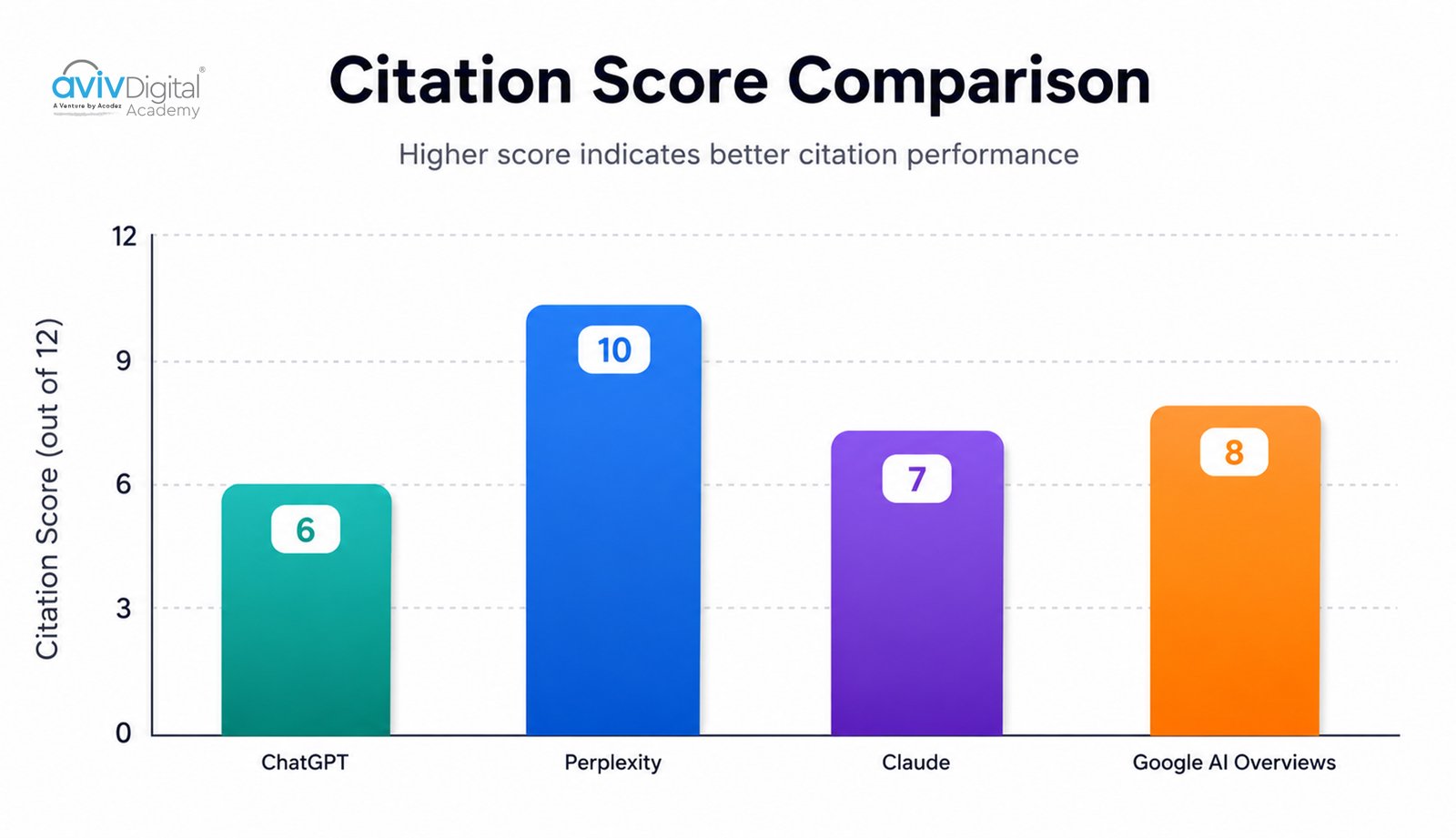
This is where the conversation breaks down in most competitive articles. All four platforms use LLMs, but they cite very differently.
ChatGPT: Dominant reach (~900M weekly active users as of February 2026), but cites selectively. Roughly a third of prompts trigger web search, and when ChatGPT does cite, it favors listicles, comparison pages, and third-party review sites over brand homepages. If you’re a SaaS company, getting mentioned on G2 or Capterra often leads to ChatGPT inclusion faster than optimizing your own blog.
Perplexity: Smaller user base but the most consistent and transparent citer. It shows its sources by default, and its algorithm favors clarity and direct answers. If you’re new to AI search optimization, Perplexity is often the easiest platform to crack first.
Claude: Highest bar for authority. It rarely cites without web search explicitly enabled, and it favors academic, well-sourced, expertise-driven content over promotional or thin material. If your content is thin or keyword-stuffed, Claude won’t touch it.
Google AI Overviews: Reaches roughly 1.5 billion monthly users but weights semantic completeness and multi-modal content heavily. The overlap with the organic top-10 varies sharply by industry, high in healthcare, low in finance. Traditional ranking position is not a reliable predictor of AI Overview inclusion in Google AI search.
| Platform | Reach | Citation Behavior | Best Entry Point |
| ChatGPT | ~900M weekly users (Feb 2026) | Selective; favors listicles, reviews | Third-party review sites (G2, Capterra) |
| Perplexity | Smaller, growing | Consistent, transparent sources shown | Brand homepages with clear structure |
| Claude | Smaller, developer/knowledge-focused | High authority bar; rarely cites without web search | Academic, well-sourced cornerstone content |
| Google AI Overviews | ~1.5B monthly users | Semantic completeness; multimodal-heavy | Depends sharply on industry; healthcare high, finance low |
The practical lesson: don’t optimize for “AI search” in the abstract. Optimize for specific platforms. Your PR strategy might target Perplexity citations first (high visibility, transparent sourcing), while your content structure and review flow might prioritize ChatGPT and Google AI Overviews.
An 8-Step GEO Framework for 2026
This is the actionable core of the strategy. Most of these steps are within your control and don’t require expensive tooling.
Audit your Current AI Footprint.
Run 20–50 buyer-intent prompts across ChatGPT, Perplexity, Claude, and Gemini. Log whether your brand is mentioned, cited, or absent entirely. Note which competitors appear instead. This becomes your baseline. You’ll use it to measure progress.
Structure Content for Extraction.
Answer the heading’s question in the first sentence. Use short paragraphs, lists, and descriptive tables. Avoid burying key information in tabs, accordions, or JavaScript-rendered-only elements that AI crawlers may not execute. If a human can’t quickly find the answer by scanning, an AI probably can’t extract it either.
Build Entity Authority.
Add an organization or Product schema with same-as links to LinkedIn, Crunchbase, and Wikidata. Keep your brand name, description, and NAP (Name, Address, Phone) consistent everywhere online. Build topic clusters with clear internal linking so AI systems understand your coverage breadth.
Earn Third-Party Citations and Reviews.
The majority of AI citations come from earned coverage, not owned pages. Prioritize press mentions, analyst reports, and original research. Build out G2, Capterra, and Trustpilot presence with a steady, recent flow of reviews rather than a one-time campaign. Each new review is a freshness signal.
Grow Presence in Communities.
Reddit, LinkedIn, and YouTube are among the most-cited domains across major AI platforms. Encourage genuine, non-promotional participation from subject-matter experts on your team. A thoughtful Reddit comment answering a real question often carries more weight than a polished blog post.
Refresh Content on a Fixed Cadence.
Set a minimum quarterly review cycle for cornerstone pages. Update statistics, refresh examples, and ensure links still work. Stale content loses citations disproportionately.
Decide Whether llms.txt is Worth Implementing.
llms.txt is a proposed (not officially standardized) root-level file that summarizes your site for AI systems. Adoption sits at roughly 10% of domains studied. Google has stated on the record that it isn’t used as a ranking or crawling signal for Search or AI overviews. Evidence that it moves citation rates in ChatGPT or Perplexity is thin to nonexistent so far. It does show real utility in the emerging agentic and developer tooling space; IDE agents and coding assistants routinely fetch it.
The practical recommendation: it’s low-cost and low-risk to add, but it should not substitute for the other seven steps. If you have the resources, implement it. If you’re resource-constrained, focus elsewhere.
Measure, Attribute, and Iterate.
Track mentions, citations, AI share of voice versus competitors, and AI-referred sessions. Treat single-answer snapshots with caution; AI answers are rebuilt per query, and visibility fluctuates run to run, so trend data matters more than any one check. A monthly tracking routine, even manual, beats no visibility work at all. The AI-visibility tooling category (Profound, Peec AI, Otterly, Scrunch, and others) raised more than $300 million in funding between mid-2025 and early 2026, useful context for why so many competing tools and methodologies exist right now.
Common Mistakes Brands Make With AI Search Visibility
- Treating it as an SEO side project. AI visibility requires cross-functional effort spanning content, PR, and product marketing. A content-only push won’t work.
- Tracking metrics without diagnosing the cause. You see a dip in mentions but don’t know why. Did a competitor publish something stronger? Did your content age out? Investigate.
- Optimizing high-performing search pages instead of deeper, structurally rich pages. AI systems often pull from cornerstone, comprehensive pages, not your top-traffic transactional pages. Optimize the right pages.
- Publishing high volumes of generic AI-written content. Volume dilutes authority. One well-sourced, original piece beats 10 generic posts.
- Never connecting visibility metrics to downstream outcomes. You’re measuring AI mentions for their own sake. Connect them to traffic lift, branded search lift, or pipeline. That’s what matters to the business.
How to Measure Brand Visibility in AI Search
Use a tool-agnostic approach. Manual prompt checks are a reasonable starting point for smaller teams.
| Metric | What It Shows | How to Track It |
| AI Mentions | How often your brand appears in AI answers, cited or not | Manual prompt audits or a dedicated AI visibility tool |
| Cited Pages | Which of your own pages AI systems cite as sources | Server logs + manual prompt audits |
| AI Share of Voice | Your share of category-level mentions versus named competitors | Monthly prompt tracking |
| AI Referral Traffic | Sessions arriving directly from AI platforms | GA4 custom channel grouping for AI referrals |
| Entity Accuracy | Whether AI describes your brand and offerings correctly | Manual spot-checks across platforms, monthly |
Start with monthly manual checks. If you’re managing dozens of keywords or competitor sets, a paid tool becomes worthwhile. But many mid-market brands can sustain real progress with a standing monthly prompt-audit routine.
A Practical 30-60-90-Day Roadmap for Smaller Marketing Teams
If you don’t have enterprise budgets, this is your path.
- Days 1–30: Audit and Quick Technical Fixes.
Run the prompt audit across four platforms. Identify your top 10 highest-traffic pages. Add or fix the organization schema. Restructure those pages for answer-first content: lead with the heading’s answer in sentence one, use lists and tables, ensure no critical information is hidden behind tabs or JavaScript.
- Days 31–60: Earn Authority Signals.
Pitch 2–3 relevant publications or directories. Launch a review-request cadence via your NPS follow-up program. Publish one original data or framework piece worth citing. It doesn’t need to be massive; a 15-question industry survey or a framework comparison can drive citations if it’s original and well-sourced.
- Days 61–90: Build a Measurement Habit.
Set a recurring monthly prompt-tracking routine. Add an AI-referral segment in Google Analytics. Schedule the first quarterly content refresh. By day 90, you’re in a system, not chasing one-off wins.
This roadmap works because it focuses on high-leverage moves (schema, answer structure, earned coverage, and review velocity) that don’t require enterprise budgets or complex tools.
Conclusion
Brand visibility in AI search is a new skill, but it’s not magic. Focus on the four trust signals: entity clarity, extractable content structure, third-party validation, and freshness. Understand how your specific platforms (ChatGPT, Perplexity, Claude, and Google) cite differently, and prioritize accordingly. For mid-market teams, the 30-60-90 roadmap keeps you resource-realistic while targeting the highest-leverage moves. Start with an audit, fix your cornerstone pages for extraction, earn third-party coverage, and measure monthly. The brands winning at AI search today are the ones treating it as a cross-functional priority, not an SEO side project. The window for early adoption in AI search is open. Brands that commit to AI-optimized content strategies now, before this becomes competitive, will establish authority and citation patterns that prove difficult for later entrants to overcome. As AI search continues to disrupt how users discover information and brands, making yourself visible and citable in these systems isn’t optional; it’s essential for staying discoverable in 2026 and beyond.
Aviv Digital Academy is one of the leading Digital Marketing Course in Calicut. We offer a wide variety of globally recognised certification programs that include SEO, SEM, SMM, Email Marketing, and Inbound Marketing courses. For more details, Contact Us at: +91 8156998844
Frequently Asked Questions
Do I need a paid AI-visibility tracking tool, or can I check this manually?
Manual prompt checks across ChatGPT, Perplexity, Claude, and Gemini are a reasonable starting point for smaller teams. Paid tools become worthwhile once you need to track dozens of prompts and competitors on a recurring schedule. Only 14% of marketers currently track AI citation visibility with dedicated tools, despite 43% naming AI search optimization a core 2026 priority, so you’re not alone.
How do I actually get my brand mentioned in ChatGPT’s answers?
Modeled directly on a live Quora thread of the same name, people want a concrete starting sequence, not theory: test your current visibility, restructure content into direct Q&A format, then build presence in the communities the model actually cites.
My Google rankings haven’t dropped, so why is my traffic still falling?
A recurring complaint in SEO forums once AI Overviews roll out on a query set is that rankings and referral traffic have decoupled, and this is worth its own answer box since it contradicts what people expect.
Is a “mention” the same as a “citation,” and does the difference actually matter?
A real point of confusion people conflate the two, then get frustrated when “visibility” doesn’t translate into traffic.
Does investing in Reddit pay off the same way for every industry, or does it depend on what I sell?
Directly answerable with the apparel-vs.-transportation and ChatGPT-vs.-Gemini variance data above, it’s a good one to preempt before readers over-index on a single trendy tactic.