Advertising is the pillar of conversion in today’s age, and it also builds brand awareness based on the creativity of the ad copy. Ad copy persuades a reader, viewer, or listener to take action, such as clicking a link, signing up, booking a demo, or requesting a quote that grants access to your product or service. Advertising copy, or Ad copy, is necessary for two important steps: attention and action. A Google ad you saw online, a promotional email, a compelling adboard you passed by are all examples of ad copies unfolded before your eyes. An ad copy can save your brand campaigns; for this reason, brands and businesses hire creative copywriting experts for campaign development to achieve their goals.
What is Advertising Copy
To understand further, let’s understand Advertising Copy comprehensively. Remember, it is often called Ad copy for convenience; therefore, ensure not to confuse yourself. It’s made or written for advertisements that are meant to persuade an audience to take a particular action. This is probably a key factor in sales of products or services, both online and offline. Unlike regular advertisements, an ad copy is meant to either grab the audience’s attention or prompt them to take an action, but mostly in a creative way. The way and ad copy are presented should also represent the product or service, such as addressing pain points, and also guide people to the next step.
You will find advertising copy in:
- Search ads
- Social media ads
- Display banners
- Print ads
- Billboards
- Promotional emails
- Landing pages
- Video ad scripts
In short, if content is built to persuade inside a campaign, it is advertising copy.
What Ad Copy Means in Marketing
In marketing, ad copy serves as the main communication tool that delivers essential messages to customers. The brand message reaches its intended audience through direct and persuasive communication, which the business creates. The design elements and target audience selection help advertisements attract attention, but the actual written content of the ad determines whether people will take action. In fact, personalized ad copy can increase conversions by up to 42%, and using power words in headlines can boost click-through rates by around 20%, highlighting how crucial the right wording is. The marketing funnel depends on ad copy to perform its essential functions throughout every stage. The process of gaining attention starts at the awareness stage. The product reveals its value to customers during the consideration stage, which creates growing interest in the product. The conversion stage requires users to take immediate action because it presents them with an urgent reason to act. Marketers need to develop special skills for writing advertisement content for this reason. A blog post provides space for extensive topic exploration, but ad copy needs to capture audience attention immediately while delivering its message in a clear and concise manner. Content writing fulfills two main functions, which involve providing information and supporting the growth of readers. The main function of advertising copy is to sell products while simultaneously transforming viewers into customers. The right advertisement text boosts the number of people who click through and creates more potential customers who become paying customers, and it establishes a stronger link between what the brand promises and what customers want to buy.
Why Advertising Copy Matters for Your Brand
- First impressions: Ad copy is often the first interaction a potential customer has with your brand, so the message needs to be clear, confident, and relevant.
- Competitive differentiation: Strong copy helps your offer stand out in crowded feeds, search results, inboxes, and marketplaces.
- Brand voice consistency: Good ad copy reinforces your tone, positioning, and personality across campaigns and channels.
- Conversion impact: Persuasive messaging helps move audiences from awareness to action more efficiently.
Businesses that invest in stronger messaging usually get more out of their paid campaigns, promotions, and lead generation efforts. That is one reason many brands combine ad strategy with broader digital marketing services.
Types of Ad Copies
Different campaigns require different formats. Understanding the main types of ad copy helps marketers choose the right structure for the right channel. This is especially important today, as global digital ad spending is projected to reach $870.85 billion by 2027, with 81% of total ad spending expected to come from digital channels by 2030, making effective ad copy more critical than ever.
- Short-Form Ad Copy
Short-form ad copy delivers short messages that people can quickly grasp when they read them. The format appears across search ads, social ads, push notifications, and display banners because these platforms need to fit their content into restricted advertising areas. The writing process demands that each word perform at its maximum potential. The combination of powerful headlines with obvious benefits and straightforward calls to action becomes a vital element for success.
Example: “Cut Reporting Time in Half. Try the Free Demo.”
- Long-Form Ad Copy
The long-form advertising content allows brands to tell detailed stories while they build trust through persuasive techniques and they respond to customer objections. The format serves sales pages, landing pages, advertorials, and direct-response email campaigns. The format serves its purpose when businesses need to explain their offer to customers and provide evidence and an emotional connection before customers will decide to purchase.
Example: “Still losing hours every week to manual invoicing? Our platform automates reminders, tracks payments, and helps your team get paid faster without adding more admin work.”
- Ad Body Copy
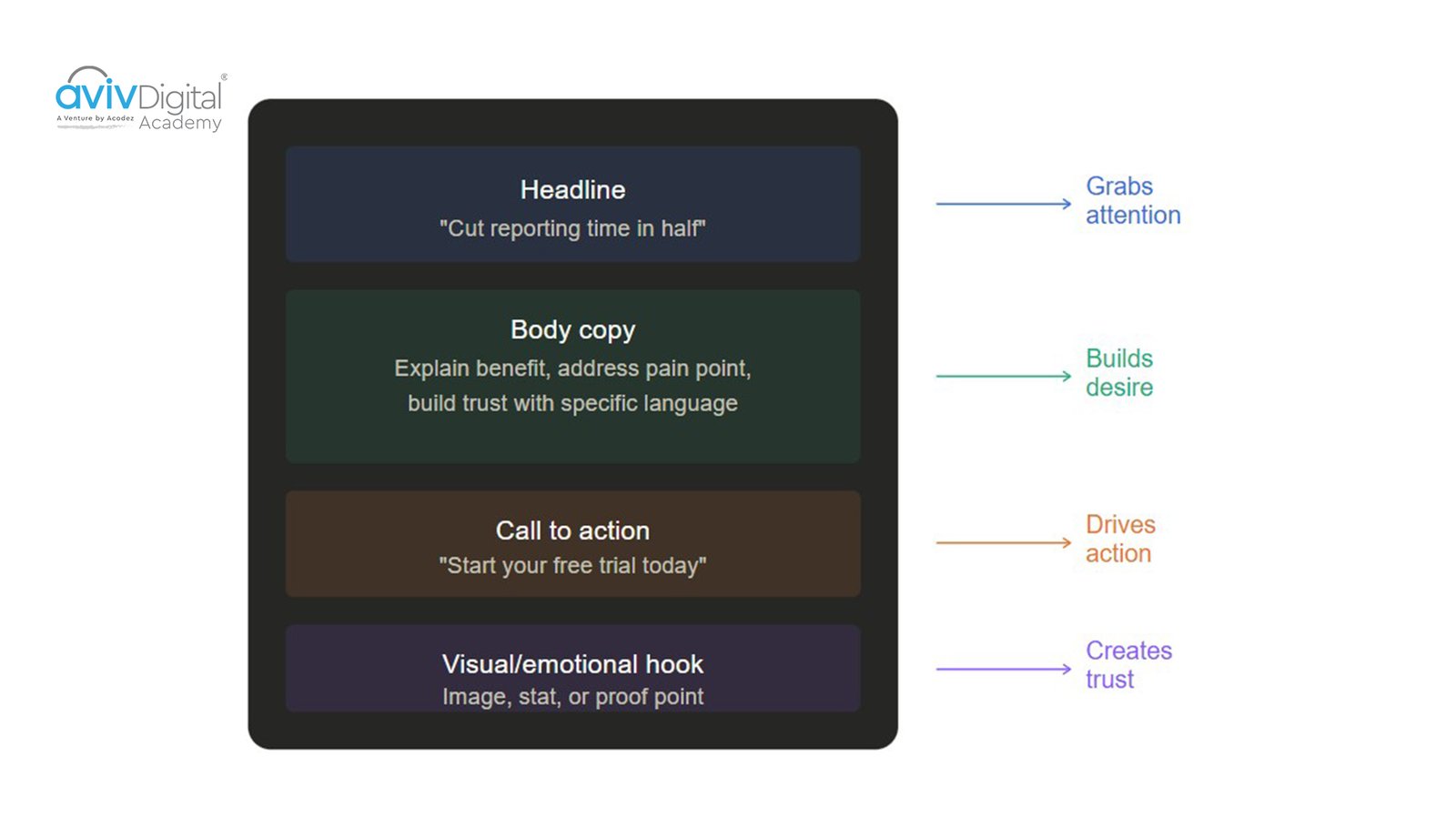
Body copy is the main supporting text in an ad. It expands on the headline, explains benefits, addresses pain points, and adds reasons to believe. In many campaigns, the headline gets the click, but the body copy closes the gap between attention and action.
What Makes Good Ad Copy
Good ad copy is not random cleverness. It follows a few core principles that make persuasion easier and action more likely.
- Clear and Compelling Headlines
The headline is usually the first thing people notice. It must grab attention immediately and communicate the main value proposition fast. If the headline is vague, confusing, or generic, the rest of the message may never get read.
- Benefits-Focused Messaging
People care less about features than outcomes. Good ad copy translates features into benefits. Instead of saying what a product has, it explains what the user gains from it.
Feature: “Includes automated reminders.”
Benefit: “Get paid faster without chasing overdue invoices.”
- Strong Call to Action
A CTA tells the audience what to do next. The strongest CTAs are clear, specific, and easy to act on.
Examples:
- Start Your Free Trial
- Book a Free Consultation
- Download the Guide
- Request a Quote
Personalization plays a huge role here. Personalized CTAs can increase conversion chances by up to 202%, and using a clear reason (like adding the word “because”) can boost compliance by 34%.
- Audience-Relevant Language
The most effective ad copy sounds like it understands the reader. It uses vocabulary, concerns, and motivations that match the target audience. A founder, a student, and an enterprise buyer do not respond to the same framing.
- Emotional Connection and Urgency
Great copy often appeals to emotion before logic. It can tap into ambition, fear of missing out, relief, confidence, belonging, or convenience. Urgency also matters. When people feel there is a reason to act now, response rates often improve.
How to Write Ad Copy That Sells
If you want to know how to write ad copy that sells, start with these practical steps. Storytelling in copy can boost engagement by up to 300%, and content supported by social proof sees around 12% higher conversions, showing how powerful the right messaging approach can be.
1. Research Your Target Audience
Strong ad writing starts with audience insight. Know who you are speaking to, what they want, what frustrates them, and what objections might stop them from acting. The more specific your audience knowledge, the more persuasive your copy becomes.
2. Lead with Benefits Over Features
Turn product details into customer outcomes. Features describe the offer. Benefits explain why the offer matters. A benefit-first message is almost always more persuasive.
3. Address Customer Pain Points Directly
The best ad copies make the audience feel understood. If your reader instantly recognizes their own problem in the message, they are far more likely to keep reading.
4. Use Action Words and Power Phrases
Strong verbs create energy and momentum. Action-oriented language helps move the reader toward a decision.
Examples of action words:
- Discover
- Unlock
- Transform
- Boost
- Save
- Grow
- Improve
- Launch
- Start
- Get
5. Include Numbers and Specific Data
Specificity builds trust. A vague promise sounds weak, while a concrete claim feels more believable.
Compare:
- “Improve productivity”
- “Save 5 hours per week on manual reporting.”
6. Create Urgency and Leverage FOMO
Urgency encourages faster action. Limited-time offers, seasonal promotions, countdowns, or limited availability can help reduce hesitation when used honestly and strategically.
7. Keep Your Message Simple
Clarity beats cleverness. The strongest ad copies usually communicate one main message with minimal friction. If the audience has to decode the point, the copy is too complicated.
8. Test and Optimize Your Ad Copies
Ad copy is never perfect on the first draft. High-performing teams test different headlines, hooks, CTAs, and body variations to improve results over time. Even small changes can produce meaningful gains in campaign performance, especially in search engine marketing.
Real Advertisement Copy Examples
Looking at ad copy examples makes the principles easier to understand in practice.
Social Media Promotional Copy Example
Example: “Still spending hours editing product photos? Create studio-quality visuals in minutes. Start your free trial today.”
Why it works: It opens with a relatable pain point, promises a practical benefit, and ends with a low-friction CTA. The language is simple, direct, and built for fast scrolling environments.
Search Engine Ad Copy Example
Example:
Headline 1: Accounting Software for Small Teams
Headline 2: Automate Invoices and Reminders
Description: Save time, reduce payment delays, and simplify billing with one easy platform. Start free today.
Why it works: It matches likely search intent, focuses on benefits, and uses a direct action phrase. It also stays close to the audience’s problem rather than listing features for their own sake.
Email Campaign Ad Copy Example
Subject line: “Last Chance: Save 20% Before Midnight.”
Body: “Your team can start creating better campaigns today. Upgrade before midnight and save 20% on your first three months.”
Why it works: The subject line creates urgency. The body keeps the message focused, offer-led, and easy to act on.
Display and Native Ad Copy Example
Example: “Cut Customer Support Tickets by 32% With Smarter Self-Service”
Why it works: It uses a clear benefit, includes a number for credibility, and appeals to a business outcome. This is the type of concise copy that works well in display and native ad placements.
Video Ad Copy Example
Example opening hook: “What if your team could launch campaigns in half the time without sacrificing quality?”
Supporting voiceover: “Our workflow platform helps marketers plan, create, review, and launch from one place.”
Why it works: The hook creates curiosity around a desirable outcome. The supporting copy quickly explains the offer and connects it to efficiency and performance.
Good vs Bad Ad Copy Examples
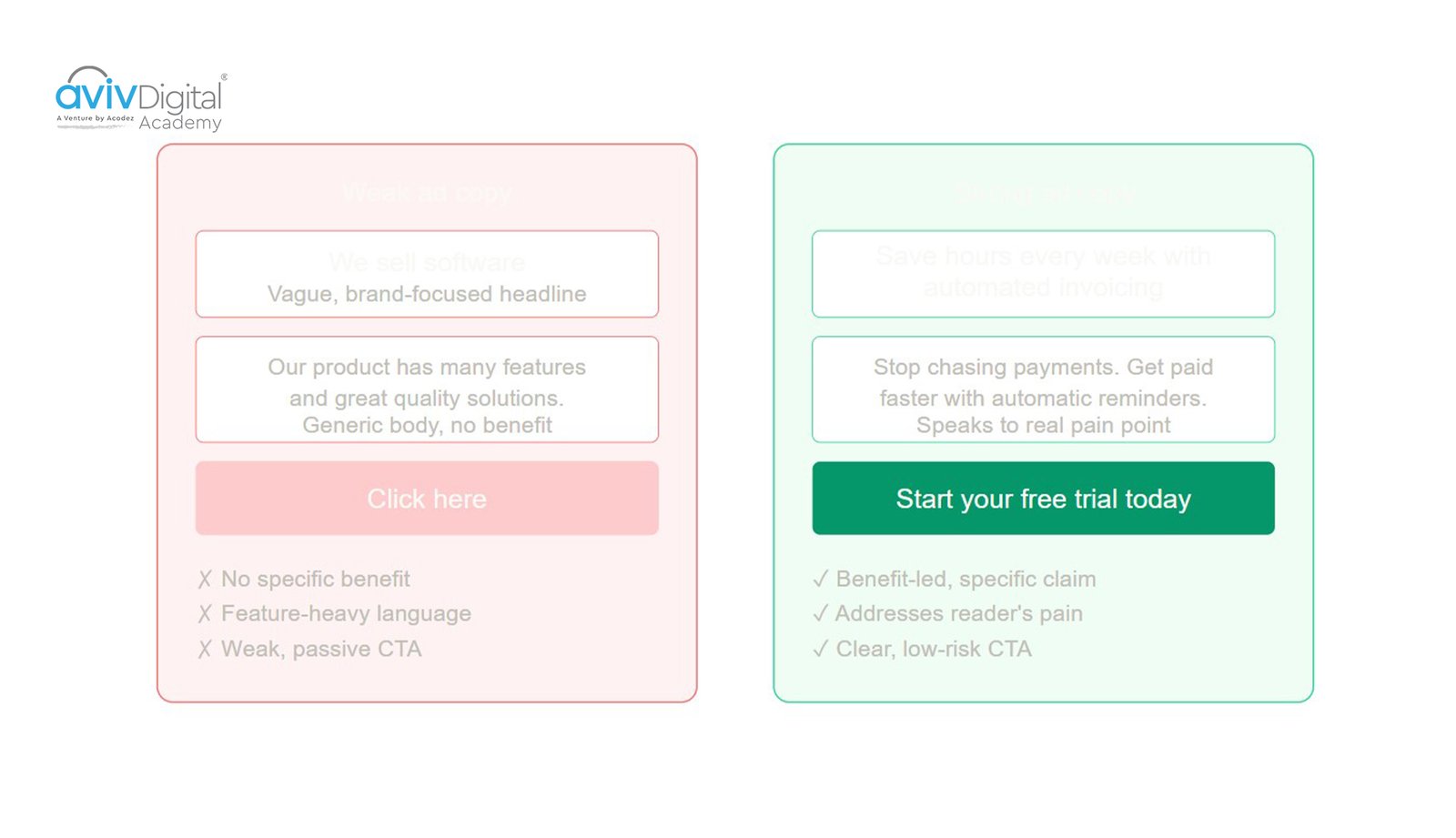
The difference between weak and effective copy becomes obvious when placed side by side.
| Element | Bad Ad Copy Example | Good Ad Copy Example | Why It’s Better |
| Headline | We Sell Software | Save Hours Every Week with Automated Invoicing | Benefit-focused and specific |
| Body | Our product has many features | Stop chasing payments and get paid faster with automatic reminders | Speaks directly to a real pain point |
| CTA | Click here | Start Your Free Trial Today | Clear, actionable, and low-risk |
Bad copy tends to be vague, self-centered, and feature-heavy. Good copy is specific, benefit-driven, audience-focused, and easier to act on.
Where Ads with Copy Are Used
Advertising copy appears almost everywhere brands communicate commercially.
Search Engine Marketing
Google Ads and Bing Ads depend on their written content because the system works through text-based information. The performance of these ads depends on how well the headlines, descriptions, extensions, and landing pages work together. The search results display depends on copywriting because it establishes the level of relevance, which determines user clicks and conversion potential.
Social Media Advertising
Facebook, Instagram, LinkedIn, and TikTok demand businesses to create distinct advertising messages for each platform. The correct format needs to change between different platforms, but the essential elements, which include capturing viewer interest, showing product worth, and requesting user interaction, remain unchanged.
Email Marketing Campaigns
The success of promotional emails, product launches, newsletters, and nurture sequences depends on good copywriting to generate email opens, link clicks, and sales conversions. Brands that want to expand their communication channel should dedicate funds to creating better email marketing systems that deliver improved messaging.
Display and Native Advertising
Banner ads, along with native placements, need advertisers to create short messages because they have restricted room for content. The website needs two essential elements to function correctly: well-designed headlines and brief text that supports them.
Video Advertising
Video campaigns require copy that appears through various elements, including hooks and scripts, captions, voice-overs, and on-screen text. The message quality directly impacts how long people stay focused and their willingness to take action. Brands that make video content need to master this particular skill.
Print and Outdoor Advertising
The advertising industry continues to rely on copywriting for billboards, magazines, flyers, and transit ads. The viewers who watch these programs need to comprehend things quickly because their attention span remains extremely brief, so they must understand everything completely.
Conclusion
Great advertising copy is a mixture of knowing your audience, creating benefit-based messages, hitting them emotionally, and having a good, strong CTA. It is both creative and strategic. Great advertising campaigns do not come from a person’s gut feeling. The advertising materials are written, tested, changed, and checked to ensure they’re in line with the brand’s purpose. It does not matter what kind of advertising materials you are writing – a search ad, social promotion, email campaign, or landing page – the main objective is to speak directly to the right audience and give them a strong incentive to do what you want. Copywriting of a professional standard is not only a nice-to-have for companies that are looking for better-performing campaigns, but also an investment in marketing efficiency, conversion quality, and brand perception. If you are willing to raise the level of your advertising copy, find a team of experienced digital marketing professionals.
Aviv Digital Academy is one of the leading Digital Marketing Course in Calicut. We offer a wide variety of globally recognised certification programs that include SEO, SEM, SMM, Email Marketing, and Inbound Marketing courses. For more details, Contact Us at: +91 8156998844
FAQs about Advertising Copy
What are the 4 C’s of copywriting?
Copywriting depends on four essential principles, which include clear and concise, compelling, and Credible content. The elements work together to create messages that people can understand easily while keeping the message short and making it convincing and reliable.
Can AI tools write effective advertising copy?
AI tools can help generate first drafts, ideas, and variations for testing, but human review is still essential. Strong ad copy needs brand judgment, audience nuance, and strategic refinement to perform consistently.
How is advertising copy different from content writing?
Advertising copy needs to persuade people while generating quick responses, but content writing serves to provide information that helps readers develop trust over time. Ad copy operates through its direct communication style, which focuses on achieving sales results and conversion goals.
How long should advertising copy be?
The platform, together with the marketing objective, will determine what constitutes the proper length. Search ads require brief text, but landing pages, together with sales emails, demand extended information. The best rule is to use only as many words as necessary to communicate value and prompt action.