A world of options makes it a better place, with the ability to make choices and pick what’s right among many. The same happens with brands and businesses; having brands that compete against each other pushes each other to be better and offers features and options to the audience. Oftentimes, competitors can set benchmarks or create new trends that benefit the whole industry. Given these facts, Competitor research, also called competitor analysis and competitor analysis tool, is crucial today for a successful Digital and industry journey. Today’s article is a comprehensive guide to competitor research, competitor analysis and competitor analysis tools, their benefits, why it is necessary and more.
What is Competitor Analysis or Competitor Research in Digital Marketing?
Prior to jumping into anything else regarding competitor analysis or how to do competitor analysis, take a moment now to once again know what competitor analysis or competitive research is in Digital marketing. Competitive analysis is the planned and systematic steps taken after identifying direct and indirect competitors by analysing their online activities, including SEO, paid ads, content, social media and others like UX product, customer feedback and pricing to discover opportunities, tactics you can inspire and use as well as trends to follow or watch out for threats. Notably, 90% of Fortune 500 companies use competitive intelligence practices like this to gain an edge. An industry-leading brand or business might set a benchmark or bring new trends or tactics that can be inspired and used by the brands or businesses in the same industry to grow and find success.
Why is Competitor Analysis Necessary?
As it may be indicated in the definition of Competitor analysis, it is an ideal and crucial process when it comes to Digital Marketing and for marketing brands or businesses. 76% of marketers adjust digital strategies monthly based on competitor monitoring. Brands using competitor data effectively see up to 21% higher ROI on digital campaigns. Using Competitor analysis tools is not a step, but necessary in many ways. A few of the popular facts on why it’s necessary are:
- Opportunity gaps: Doing SEO competitor Analysis with top competitive research tools makes you able to find significant opportunities like Keywords, Content topics and specific ads all before you invest to see how it turns out to be.
- Benchmark Performance: Following top brands or businesses reveals what the trends or standards are in your niche or industry
- Risk-free launching facility: Understanding facts from competitors, like pricing, features, would let one know the trend and how rivals reacted to it. This helps to rightly value a product or service.
- Enhance strategy: SEO competitor analysis enables learn what works in the niche or specific audience. A competitor who took a risk might pave the way to new tactics that work, helping to enhance one’s marketing strategy.
Data to gather from competitors
Competitor analysis is not about collecting random information. Effective competitor analysis requires relevant, actionable data that supports better decision making. The areas to focus while collecting data include :
SEO and Content Data
This includes top-ranking keywords, content topics, blog formats, backlinks and internal linking strategies.
Paid Advertising Data
Analyze paid keywords, advertising text, Landing Pages (LPs), Promotions, Estimated Ad Spend (EAdS) and Campaign Prioritisation, Messaging Conversion.
Website and User Experience
Review how competitors’ websites are structured, loading speeds (page load times), mobile-friendly experiences, navigation flow and CTA placements. UX research provides many insights into what difficulties users encounter when trying to navigate through a site, and how to improve that experience.
Product, Pricing and Offers
Benchmark against competitors’ pricing models, features, tiers, discounts and value proposition. Comparing this information with your own will allow for better pricing and positioning strategies.
Brand Messaging and Positioning
Tracking the tone of voice, taglines, visual identity and brand promise of competing companies will provide insight into the consistency of their messaging across all online platforms including social media. By tracking this type of metric it is clear what the competition wishes to be known for.
Customer Reviews and Feedback
Research competitor reviews on Google, other marketplace websites and on social media. This research will provide insight into the most common complaints or unmet expectations, and will also identify areas of satisfaction or strength for customer recognition.
Benefits of Competitor Analysis
Competitor analysis helps in identifying gaps in the market and improving their direction. Businesses use competitor analysis to allow them to make data-driven choices. The goal is to find and uncover weaknesses in competitors’ strategies that can be leveraged by the organization. In addition, competitor analysis allows companies to best optimize products, pricing and marketing programs. Consequently, businesses will remain in touch with trends in their industries, not make costly errors, and position themselves as uniquely valuable contributors within the industry marketplace.
Some of the major benefits of competitor analysis are :
- Stronger Marketing and Business Strategy
Competitor analysis can give brands insight into how competitors are succeeding in the marketplace; therefore, knowing what works provides for better planning and prioritizing.
- Identification of new opportunities
By analyzing what competitors are not doing well or what they lack, brands can find opportunities that were not previously considered, before they invest significant amounts of their resources.
- Improved decision-making
Data gathered through competitor analysis is helpful to make confident decisions on campaigns, pricing and product development.
- Better Market Positioning
Reviewing the weaknesses of competitors gives a brand an advantage by allowing for a position to be created that gives the brand the greatest chance to be successful and therefore successfully creates differentiation.
- Risk Reduction and Early Trend Detection
Staying current on the activities of one’s competitors allows brands to be aware of and ready for changes in their respective industries as they happen.
Pitfalls to Avoid While Using Competitor Analysis Tools
Though a necessary step in Digital marketing for brands or businesses with numerous benefits, there are certain common mistakes that damage the seo competitor analysis and the brand’s reputation. Take note of these mistakes to avoid while using SEO competitor analysis.
- Copying and hesitating to adapt: SEO competitor analysis is an effective strategy only due to the uniqueness and flair offered by each brand or business. Replicating is a common mistake in Website competitor analysis. Instead of getting inspired or taking reference, implementing the exact same thing could damage the brand’s status.
- Focusing on a few competitors: Focusing on a few competitors, like the biggest players and vice vers, a like following the direct competitors is a pitfall to avoid while doing SEO competitor analysis. Focus on relevant, if not all, competitors to understand, try and test out what works, what doesn’t work and so on.
- Irregular competitor analysis: new trends, tactics, and tech emerge quickly in the online realm, and constantly doing Website Competitor research is the ideal way to implement it. Not being updated or consistent is a piquant way of falling back.
- Over-reliance on tools: though there are numerous competitor analysis tools, relying too much on them without considering other factors or personal expertise wastes all the effort; therefore, try not to make the same mistake.
Other mistakes or drawbacks include a lack of ethics, not respecting privacy or copyright rules and regulations. Being marked as a red flag online must be avoided at any cost, and considering these factors is crucial.
How to Identify Competitors?
Identifying right competitors is crucial in competitor analysis as it can influence decisions. Here is a step by step explanation of identifying competitors accurately before competitive analysis.
Step 1 : Define your product, service and target audience
Clearly understand what you offer and who your target audience are. Your competitors are businesses offering similar solutions by targeting the same audience.
Step 2 : Identify direct competitors
Direct competitors are businesses offering the same products or services. Customers will make a decision by comparing them with you before purchase.
Step 3 : Identify indirect competitors
Indirect competitors are businesses that offer a different product which solve the same problem. This can influence customer decisions and take away a significant portion of market share.
Step 4 : Identify aspirational competitors
Aspirational competitors are bigger brands in your field whom you want to benchmark against. Analyzing them will help you to learn more about industry standards, innovation trends and long-term growth opportunities.
Step 5 : Validate competitors using real data
Use customer feedback, review platforms, paid ads and Google search results to identify the competitors you missed.
How to Do Competitor Analysis
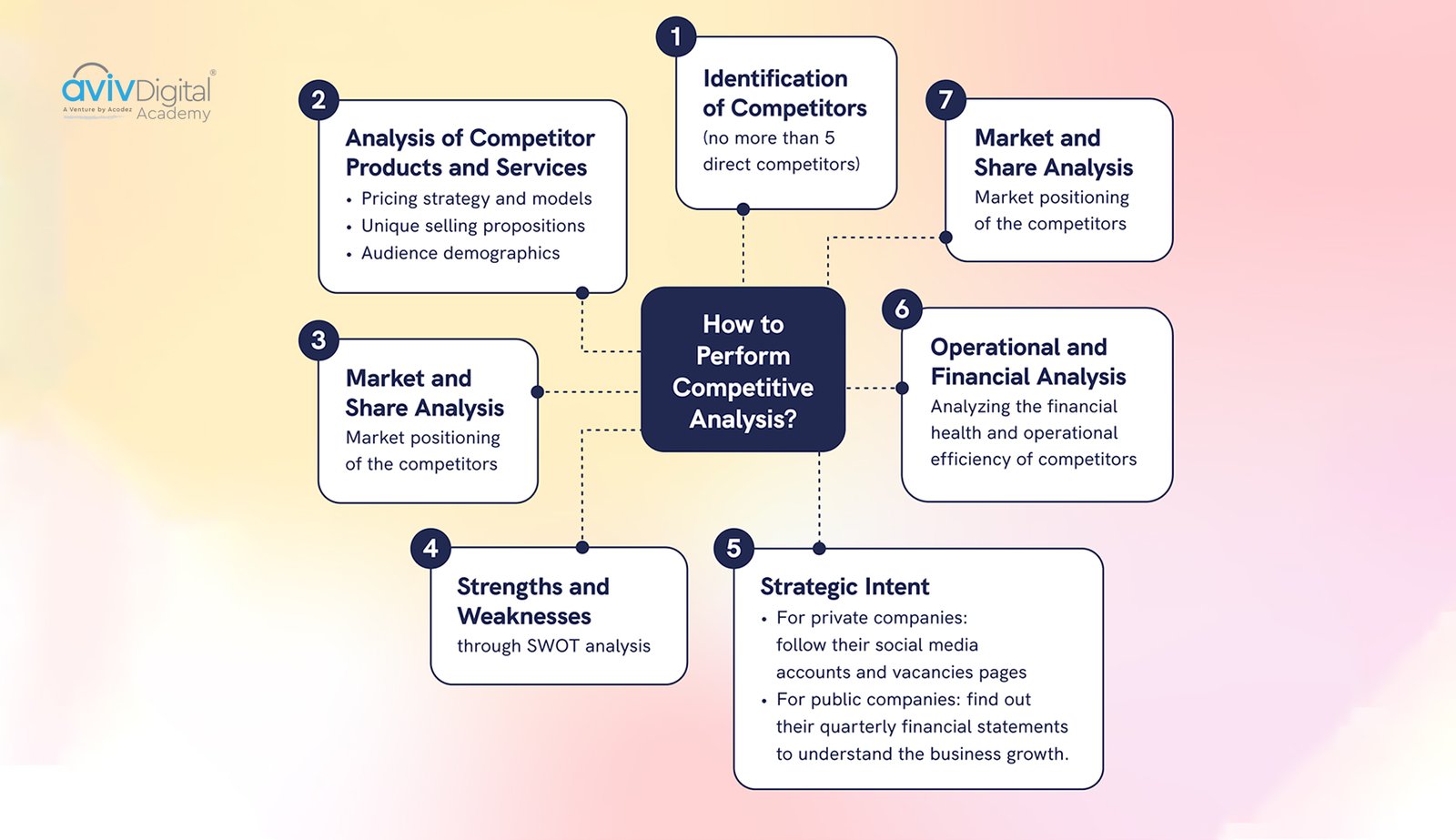
After knowing all these from what competitor analysis is, the benefits of competitor analysis, let’s learn how to do competitor analysis and the best tools for competitor analysis
- Define scope & goals: Decide what you want to learn, such as SEO gaps, paid strategy, content, pricing, UX, or product features. Set clear KPIs.
- Identify competitors (three tiers)
- Direct: Same product/service + same audience.
- Indirect: Different product but solves the same problem.
- Aspirational: Bigger brands you’d like to match.
Ask customers who else they considered it often reveals competitors you missed.
- High-level market snapshot: Collect quick data: estimated traffic, primary channels, core product lines, price ranges, star ratings and geographic focus. This orients deeper research. Tools like SimilarWeb or SEMrush give fast overviews.
- Channel-by-channel analysis: Work channel-by-channel and capture specific intelligence such as SEO, Top organic keywords, ranking pages, content gaps, backlink profile and technical issues.
- Paid Search (SEM/PPC): Study Competitors’ top ad keywords, ad copy, landing pages, estimated spend and seasonal bursts.
- Social & Content: Analyse Top-performing posts, engagement, format mix (video vs image), influencer partnerships and posting cadence to implement similar to your brand or business.
- Product / Pricing / UX: Monitor Price points, delivery promises, return policies, and checkout flow friction points. Manual shopping and mystery-shop tests to see if it works best here.
- Reviews & Customer Feedback: Ensure not to miss out or prioritise reviews and feedback. Analyze reviews on Google, Amazon, and industry directories to identify recurring praise or complaints.
- Synthesise: SWOT & Opportunity Map; Turn findings into a concise SWOT per competitor and a prioritised opportunity map.
- Test & Iterate: Run small experiments (A/B tests, landing-page variations, ad creative tests) to validate hypotheses derived from the analysis. Re-run competitor scans monthly or quarterly, depending on market speed.
Best Tools for Competitor Analysis
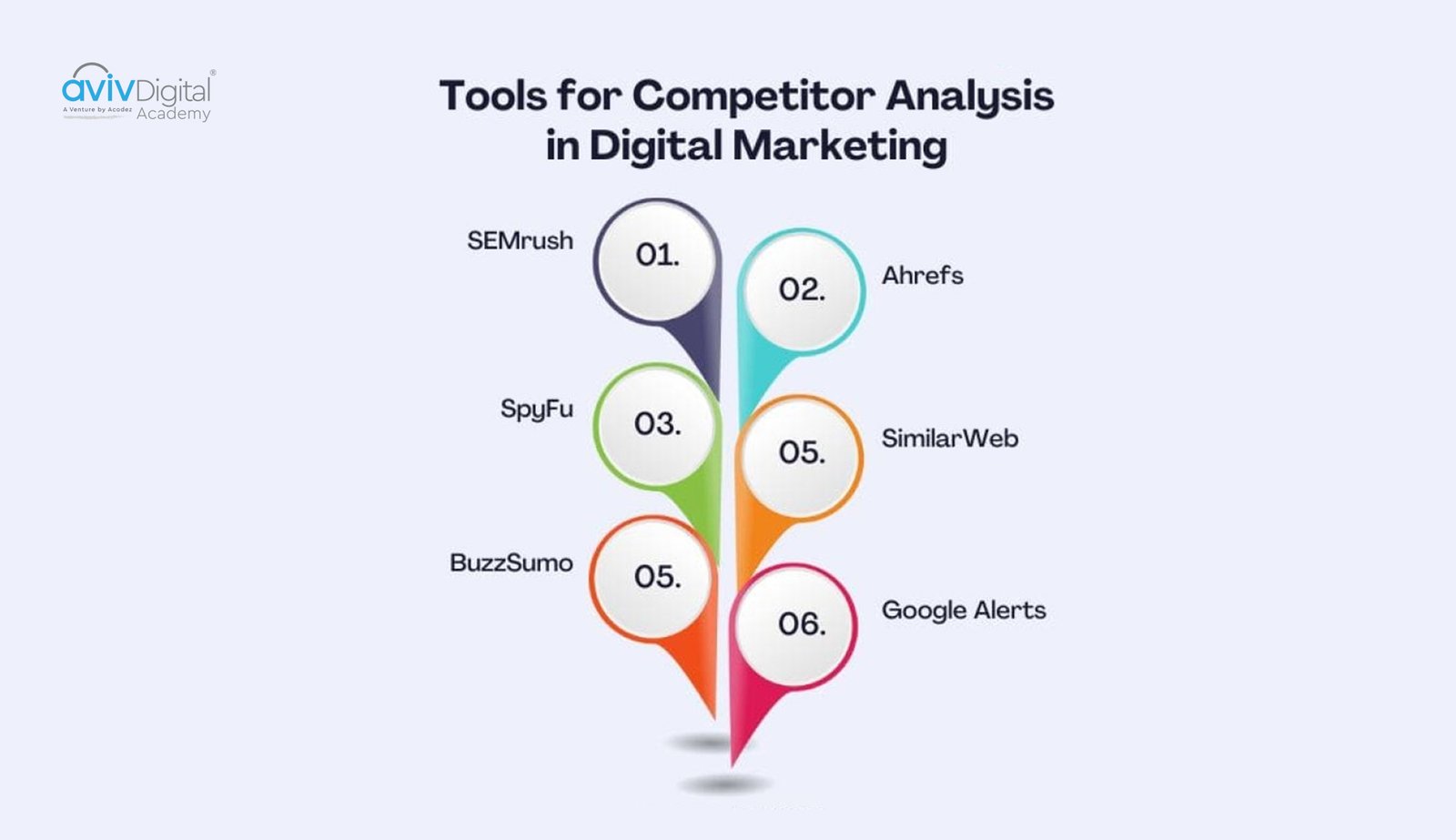
Since you might be aware of how to do competitor analysis, it’s now time to explore the best tools for competitor analysis to implement an effective Competitor Analysis Strategy. Remember to test and utilise multiple top competitor analysis tools to see what works best. Not a single tool is a one-step solution for all.
SEMrush: SEMRush is an all-in-one tool for organic keywords, paid search, backlink audit, site audits, and advertising research. It’s great for comprehensive competitor benchmarking.
Ahrefs: Best for backlink research and content gap analysis. They are also an excellent Site Explorer for organic traffic estimates.
SimilarWeb: For High-level traffic intelligence and channel mix (referrals, social, search), strong for market share snapshots. SimilarWeb is a great choice.
SpyFu: Excellent for competitor PPC history, ad copy and keyword overlap. Due to its features, it’s a good value for paid-search spying.
BuzzSumo: For Content intelligence and top-shared content like influencers, and content resonance by topic. It can be used to model content strategy.
Screaming Frog: It is a Technical SEO crawler for mirror-crawling competitor sites to find structural issues and opportunities.
BuiltWith / Wappalyzer: Technology stack reconnaissance (CMS, analytics, tag managers, payment providers). Helpful for partnership or integration planning.
Brand24, Mention and Brandwatch: Social listening and sentiment tracking across platforms and news sources.
Google Alerts & People Also Ask / SERP features: Free, fast checks to catch mentions and visible SERP opportunities. Since it’s from the largest search engine in the world it’s highly effective.
Hotjar or FullStory: Compare user behaviour with inferred competitor UX patterns after running tests.
Role of AI in Modern Competitor Analysis
Artificial Intelligence has impacted the process of competitor analysis. Instead of manually researching competitors, AI now enables faster, deeper, and more predictive analysis of potential competition. As such, AI-powered tools play a crucial role in modern competitor research.
Automated Data Collection
Artificial Intelligence tools can track the changes made by your competitors in website design, advertising, keywords used, and content.
Pattern Recognition and Predictive Insights
Businesses can use machine-learning models to identify trends, identify patterns of performance, and determine where they can change strategies to anticipate their competitors.
Sentiment and Review Analysis
Analyzing thousands of customer reviews and social media comments using AI tools allows businesses to identify sentiment trends, identify common complaint areas, and identify emerging consumer expectations.
Content and Keyword Gap Detection
AI tools for Search Engine Optimization (SEO) can quickly provide marketers with a list of keywords they are missing, which areas on their website are not performing well in terms of SEO relative to their competition, and areas for growth relative to their competitive set.
Faster and Smart Decision-Making
By integrating large sets of data into actionable insights, businesses can make better, faster, and more accurate decisions.
Conclusion
In summary, SEO or Website Competitor analysis has turned out to be a necessary step in Digital marketing or SEO in specific. Though it’s not a copy or replication, it requires to adapt change or adding something that represents one’s own brand or business. Yet competitor analysis offers peak benefits given the efforts put into it. By the end of this article, you may have learned What is Competitor analysis or what is SEO competitor analysis is in specifically followed by how to do competitor analysis and the best tools for competitor analysis. Make sure to test and always be open to learn adapt and implementing such tactics for an effective marketing journey.
Aviv Digital Academy is one of the leading Digital Marketing Course in Kerala. We offer a wide variety of globally recognized certification programs that include SEO, SEM, SMM, Email Marketing and Inbound Marketing courses. For more details, Contact us at: +91 8156998844
FAQ
1. How often should I update competitor data?
For fast markets (retail, travel), monthly or quarterly updates might be enough. For slower B2B markets, quarterly or biannually, but keep an eye on sudden competitor activity (big ad spikes or product launches) and run ad-hoc checks when needed.
2. Are competitor analysis tool estimates reliable?
They’re directional. Use multiple tools and your internal analytics to validate hypotheses. You can pair multiple tools to do the process.
3. How much time does a meaningful competitor analysis take?
A compact scan can be done in 1 or 2 weeks. A deep, channel-by-channel analysis with testing and implementation typically takes 6 to 12 weeks to move from insight to measurable impact.
4. Can small businesses benefit from competitor analysis?
Sure! Small or medium-scale businesses that are projected or aspiring to grow can get the biggest ROI because they can quickly adopt the discovered tactics to expand or scale their business.
5. Do I need paid tools?
Paid tools speed up research and provide historical data. But you can start with free options (Google Search Console, Google Ads Auction Insights, Google Alerts, manual SERP checks) and add paid tools as needs grow.