No, AI is not replacing digital marketing, but it is reshaping the profession at its core. It can automate the repetitive work, data analysis, first-draft copywriting, and ad-bid optimization, but it cannot originate creative ideas, read human emotion, set strategic direction, or tell a brand’s story with real feeling. The consensus among marketers is simple: AI won’t replace you, but a marketer who knows how to use it will.
What Is AI in Digital Marketing?
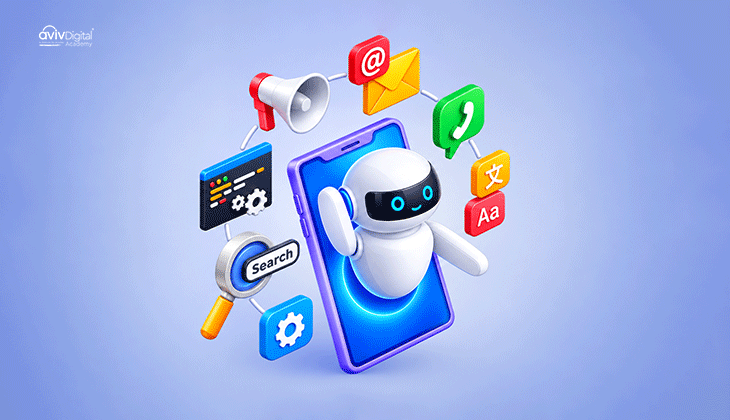
AI in digital marketing means using machine learning and generative AI tools to plan, create, personalize, and optimize marketing activities, everything from writing ad copy and blog content to predicting which customers are about to convert. In practice, it isn’t one product. It’s a layer now built into almost every platform marketing teams already use: Google Ads, email software, social schedulers, and analytics dashboards, quietly running in the background of tools people use every day.
Understanding where that layer genuinely helps and where it still needs a human in charge is what actually answers the “will AI replace digital marketers” question. That’s what the rest of this article breaks down.
- Content creation: Tools like ChatGPT, Claude, and Gemini can draft blog posts, ad copy, and social captions in minutes. But left alone, AI content reads like everyone else’s AI content; it still needs a human feeding it brand voice, audience insight, and a point of view.
- Social media scheduling & responses: AI-assisted schedulers and Meta’s own Business Suite can queue posts and draft first-pass replies to common questions, freeing up hours every week for community-level judgment calls.
- Email marketing: Platforms like HubSpot and Mailchimp use AI to personalize send times and subject lines automatically, lifting open rates without a marketer manually A/B testing every send.
- Chatbots: Conversational tools and WhatsApp Business AI flows handle FAQs and lead qualification 24/7, so human support time goes to the conversations that actually need a person.
- Predictive analytics: AI built into GA4 and ad platforms flags which audience segments are about to convert or churn, often before a manual report would catch it.
- SEO & keyword research: Tools like Surfer SEO and Semrush’s AI features suggest keyword gaps and content structure by analyzing what’s already ranking, cutting research time that used to take hours.
These are real productivity gains, not replacements. Every one of these tools performs only as well as the human briefing it, and none of them can decide why a campaign should exist in the first place.
What can AI not replace?
Since you are aware of its capabilities, let’s look at what AI cannot replace for you to strengthen your skills and focus on them to upskill, enhance, and make you an irreplaceable asset.
- Creative judgment: AI can generate a hundred headline variants. It can’t tell you which one fits your brand’s personality or which cultural reference will actually land in Kerala versus Delhi.
- Brand voice and trust: A brand’s tone is built from years of specific choices. AI can mimic a style you feed it, but it can’t originate the judgment calls that built that style in the first place.
- Cross-channel and relationship work: Negotiating with an influencer, reading a client’s unstated concern in a meeting, timing a campaign around a festival or cultural moment- none of this is something a model can do unsupervised.
- Accountability: When a campaign underperforms or a claim turns out to be wrong, someone has to own that decision and adjust. AI doesn’t carry consequences; marketers do.
How will AI replace Digital Marketing roles?
Realizing what AI can do and what AI can’t do, why don’t we explore how AI will replace digital marketers? From turning regular content writers into content strategists to compelling digital marketers to do so. Roles are shifting:
| Role | What’s Changing |
|---|---|
| Content Writer → Content Strategist | Writing shifts from first drafts to editing AI output, injecting brand voice, and deciding what’s worth publishing at all. |
| SEO Executive → AI-SEO / GEO Analyst | The job expands beyond keyword rankings to also optimizing for citations inside AI overviews and chatbot answers. |
| Social Media Manager → Social & Community Strategist | AI handles scheduling and first-response drafts; the human role shifts to community judgment and crisis response. |
| Ads Specialist → Performance Marketing Manager | Platforms like Performance Max and Advantage+ handle bid optimization; the human role shifts to campaign structure, budget strategy, and creative direction. |
| Marketing Analyst → Marketing Insights Lead | AI surfaces the patterns; the human role shifts to translating those patterns into decisions the business will actually act on. |
| AI / GEO Specialist (net-new role) | A role that barely existed two years ago, owns how a brand shows up inside AI-generated answers, not just in search rankings. |
How to stay relevant in the AI era?
Staying ahead doesn’t mean learning every AI tool that launches. It means being deliberate about which skills actually compound:
- Learn the tools relevant to your specialization. A performance marketer needs Performance Max and Advantage+ fluency; a content marketer needs prompt engineering and AI content-editing skills. You don’t need both.
- Get comfortable with data. GA4, basic reporting logic, and dashboard reading are no longer “nice to have.” They’re the layer AI can’t fully replace because someone still has to decide what the data means for the business.
- Build the skills AI can’t fake. Brand judgment, client relationships, and the ability to explain why a strategy works, not just what a tool recommends, are what keep a marketer in the room.
- Choose structured learning over trial-and-error. A course built around 2026’s actual tools and workflows gets you industry-ready faster than piecing it together from scattered tutorials, especially when it’s taught by people already running AI-integrated campaigns.
Final thoughts
AI in digital marketing isn’t slowing down, and neither is the question of whether it replaces marketers. The data says it doesn’t; it’s ended the version of digital marketing that ran on autopilot, not the profession itself. Hiring is up, salaries for AI-fluent marketers are up, and the field is still growing faster than most others in India. The marketers who get replaced aren’t being replaced by AI; they’re being replaced by other marketers who learned to use it first.
Aviv Digital Academy is one of the leading Digital Marketing Courses in Kerala. We offer a wide variety of globally recognized certification programs that include SEO, SEM, SMM, Email Marketing and Inbound Marketing courses. For more details, contact us at: +91 8156998844
What is AI in digital marketing?
AI in digital marketing is the use of machine learning and generative AI tools , like ChatGPT, Performance Max, and predictive analytics , to plan, create, personalise, and optimise marketing campaigns. It spans content creation, SEO, paid ads, email, and customer service, and now sits inside most marketing platforms as a built-in layer rather than a separate tool.
Will AI completely replace digital marketers in 2026?
No. AI automates repetitive, rule-based tasks , reporting, scheduling, and first-draft content , but hasn’t replaced strategy, judgment, or accountability. The marketers losing ground are the ones who only ever did the automatable part of the job.
Which digital marketing roles are most at risk from AI?
Roles built almost entirely around manual execution, basic reporting, manual bid adjustments, and repetitive scheduling are shrinking fastest. Roles owning strategy, client relationships, and campaign judgment remain the most stable.
How is AI changing SEO for digital marketers?
SEO is shifting from ranking for keywords to being cited inside AI-generated answers (GEO/AEO). Marketers now need to structure content for direct citation by AI overviews and chatbots, not just for search-ranking position.