Digital marketing skills are no longer just about running ads and posting on social media. In 2026, hiring managers want marketers who pair the classic skills – SEO, content, and analytics – with the AI skills that make every campaign faster and sharper. One person with the right combination now does the work that used to take a team of three.
The good news is that none of this is out of reach. The skills are learnable, most of the tools have free tiers, and the highest-quality certifications from Google and HubSpot cost nothing. This guide covers the digital marketing skills employers actually want, the AI skills changing the job, and a learning path that takes you from beginner to job-ready.
What Are Digital Marketing Skills?
Digital marketing skills are the abilities that let you attract, convert, and retain customers online. They break into two broad groups. The first is the marketing layer: search engine optimization, paid advertising, content, social media, email, and analytics. The second is the execution layer: the tools and judgment that turn a strategy into a live campaign and then prove it worked.
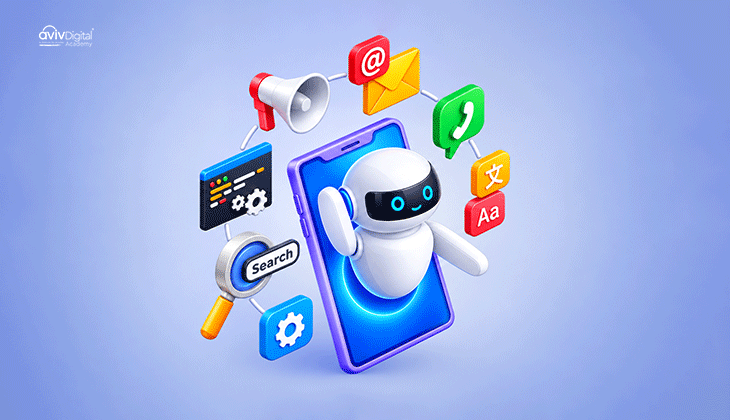
What has changed is that AI now sits across both layers. Marketers still need to understand why a campaign works, but they increasingly use AI to produce, optimize, and report on it. That is why the most valuable digital marketing skills in 2026 are the ones that combine judgment with tool fluency.
The Core Digital Marketing Skills Employers Want in 2026
Employers rarely ask for one skill in isolation. They ask for a stack. The seven sections below are the digital marketing skills that show up most often in 2026 job descriptions: what each one actually involves and why an employer pays for it.
SEO and Content Strategy
Ranking on Google still matters, even as AI search changes how results appear. The working skill is keyword research, on-page optimization, and reading search intent well enough to know what a page has to answer before you write a word. Gartner predicts traditional search volume will fall by 25% by 2026 as AI assistants take over more queries. That does not make SEO less valuable; it means the marketer who understands both classic ranking and how AI answers surface brands is the one who keeps the traffic.
Paid Advertising
Google Ads and Meta Ads are the two channels most businesses run first, because they produce results in days rather than months. The skill is audience targeting, bidding strategy, and creative testing, plus the discipline to kill a campaign that is not converting. Paid work is unusually easy to prove in an interview, since every rupee spent has a number attached to it. That measurability is exactly why employers hire for it early.
Content Marketing
AI can draft quickly, but someone still has to set the angle, fact-check the output, and keep the brand voice consistent across every piece. Content marketing in 2026 is less about typing and more about editorial judgment: what to publish, for whom, and in what order. A marketer who can take an AI draft and turn it into something a reader trusts is worth more than a writer who ignores the tools or one who publishes them unedited. The editing eye is the skill, not the typing speed.
Social Media Marketing
Organic reach has fallen across every major platform, so posting on a schedule is no longer a strategy. The real skill is community building, short-form video, and knowing when an algorithm rewards one format over another. Good social marketers read their own analytics weekly and adjust the format before they adjust the budget. They also know which platform their audience actually uses, rather than trying to be present everywhere at once.
Email and CRM Marketing
Email consistently delivers the highest return per rupee spent in most campaigns, and it is the one channel you own outright. The skill is segmentation, lifecycle messaging, and using a CRM like HubSpot to automate sequences that would otherwise take a team. A well-built welcome flow or cart-recovery series keeps earning long after you finish setting it up. Employers notice candidates who can show a flow they built and the numbers it produced.
Marketing Analytics
Being able to read Google Analytics 4 and explain what actually drove a result, not just what got clicked, separates senior marketers from junior ones. The skill covers event tracking, channel attribution, and building a report a non-marketer can act on. It is the hardest skill to fake in an interview and the one that makes every other skill sharper, because you cannot improve a campaign you cannot measure. Learn it early, even if numbers are not your instinct.
Conversion and Experimentation
Small changes to a landing page, a headline, a form field, or the position of a button can lift results sharply. The skill is designing a fair test, running it long enough to mean something, and trusting the data over your own preference. Marketers who experiment routinely compound their results instead of restarting from scratch each quarter. This combination of curiosity and statistical honesty is rare, and it is well paid.
These seven are the foundation. They are also exactly what a structured digital marketing course teaches in sequence, which is why a guided curriculum beats random YouTube tutorials for most people.
AI Skills: The Fastest-Growing Layer of a Marketing Career
AI skills are the newest requirement on a marketer’s resume, and they are no longer optional. McKinsey’s State of AI research found that 80% of respondents said AI had improved their individual productivity. In marketing specifically, that means one person can now handle research, copy, images, and reporting in a fraction of the time.
The skills for AI work that matter most are not deep programming. They are practical, learnable, and covered one by one in the five sections below.
Prompt Engineering
Prompt engineering is writing clear, structured instructions that get useful output from ChatGPT, Claude, or Gemini on the first or second try instead of the tenth. The craft is in the specifics: give the model a role, the audience, the format you want, and an example of good output. Marketers who prompt well save hours a week and produce material that needs light editing rather than a rewrite. It is the cheapest AI skill to learn and the one that pays back fastest.
AI-Assisted Content Production
This is using AI for research, outlines, and first drafts, then editing hard for accuracy, tone, and originality. The workflow that works is human brief, AI draft, human edit, never AI brief, and AI publish. You stay responsible for every claim in the copy, which means checking anything the model states as fact. Done properly, one marketer can keep a blog, a newsletter, and a social calendar running at once.
AI in SEO and Answer Engines
Search results now include generated answers that cite a handful of sources, and getting cited is a discipline of its own. The skill is understanding how AI overviews and answer engines select brands, then structuring pages so they are easy to quote: direct answers near the top, clear headings, and verifiable facts. We cover this in depth in our AI SEO guide. Marketers who understand it are protecting traffic that classic ranking alone no longer guarantees.
AI for Paid Campaigns
Every major ad platform now ships AI features for copy, audiences, and budget allocation, and using them well is a skill in itself. The job is to feed the system good inputs, read what it does with them, and step in when automated bidding drifts away from your actual goal. AI assistants are also useful for spotting underperforming creative faster than a manual review would. The marketer sets the strategy; the platform handles the volume.
AI Literacy and Judgment
This is the skill that holds the rest together: knowing what AI gets wrong, checking its facts, and never publishing something you cannot defend. It includes an awareness of bias, hallucinated sources, and the privacy rules around what you paste into a public tool. Employers increasingly ask candidates how they verify AI output, because the cost of a confident, wrong claim lands on the brand. Judgment is the part of the job that does not automate.
Why AI Skills Matter in Digital Marketing
AI skills aren’t replacing the essential skills covered above; they’re changing how fast a marketer can put them to work. The marketing layer still answers what to do and why; the AI layer helps marketers execute those decisions faster and more efficiently.
AI adoption is already widespread across marketing. Roughly 75% of marketing organizations are using or experimenting with AI, while Gartner predicts that by 2028, 60% of brands will use agentic AI to facilitate streamlined one-to-one customer interactions. Gartner
Search behavior is changing at the same time. Gartner predicts that traditional search-engine volume could decline by around 25% by 2026 as users increasingly turn to AI chatbots and virtual agents. Gartner: Search Engine Volume Will Drop 25% by 2026. This is why Generative Engine Optimization (GEO) is emerging alongside traditional SEO rather than simply replacing it.
The productivity case is equally compelling. McKinsey’s State of AI research found that 80% of respondents said AI had improved their individual productivity. For marketers, this can mean faster research, content creation, analysis, campaign planning, and reporting.
The job market reflects this shift. Data from LinkedIn shows that marketing job postings requiring AI literacy increased 113% year over year, while only around 4% of marketers globally had added AI skills to their professional profiles.
The takeaway is simple: AI isn’t replacing SEO, content, analytics, strategy, or creativity. It’s becoming a force multiplier for those skills. Marketers who develop AI capabilities can execute faster, automate repetitive work, and adapt more effectively as search and customer behavior evolve.
How to Build Digital Marketing Skills and AI Skills
There is a right order to this, and it is not “learn everything at once.” Start with one foundation skill, add one growth skill, then layer AI on top of work you already understand.
Step 1: Learn the marketing fundamentals first. SEO and analytics are the two hardest to fake and the two that make every other skill stronger. If you only have time for one structured course, make it one that covers both with real projects, not just videos.
Step 2: Get certified for free. Google Skillshop offers free courses and certifications across Google Ads, Analytics, and more. HubSpot Academy has helped 200,000+ professionals who have grown their careers with free, globally recognized certifications in inbound, content, social, and email. Both are genuinely free, and both are recognized by employers.
Step 3: Build proof, not just knowledge. Run a small campaign, optimize a real website page, or write and promote content for a local business. A portfolio with one real result beats a long list of certificates with no evidence behind them.
Step 4: Add AI skills last, after the fundamentals. Once you understand SEO, prompt an AI tool to draft a meta description, and you will instantly see what is good and what is generic. That judgment is the thing employers are actually hiring for.
If you want this sequence handled for you, the Diploma in Digital Marketing + AI runs for 4 months, covers 25+ modules, and ends with a live project and placement assistance. You can also start lighter with our digital marketing fundamentals path or go deeper with the advanced digital marketing course.
Conclusion
Digital marketing skills will get you the interview. AI skills will get you the job. The two are no longer separate career tracks; they are one stack, and the people who build both are the ones moving fastest in 2026. Start with the fundamentals, earn a few free certifications, and build one real project as proof. If you would rather follow a guided path than piece it together alone, book a free demo session and see how a structured curriculum gets you there faster.
Aviv Digital Academy is one of the leading Digital Marketing Course in Calicut. We offer a wide variety of globally recognized certification programs that include SEO, SEM, SMM, Email Marketing, and Inbound Marketing courses. For more details, Contact Us at: +91 8156998844
What are digital marketing skills?
Digital marketing skills are the technical, analytical, creative, and strategic abilities marketers use to plan, run, and measure campaigns across digital channels, SEO, content, paid ads, email, social media, data analysis, and, increasingly, AI tools like prompt engineering and generative engine optimization.
What is the most important digital marketing skill in 2026?
There isn’t a single most important skill, the strongest marketers pair one core channel skill, such as SEO, content, or paid media, with AI fluency, especially prompt engineering and generative engine optimization, since AI-powered search is reshaping how audiences discover brands in the first place.
Do digital marketers need to learn AI skills?
Yes. Marketing job postings requiring AI literacy have grown sharply year over year, and most marketing organizations already use AI in some form. Marketers who can direct AI tools while applying strategy and judgment are increasingly preferred over those who can’t.
Which AI skills are most in demand for digital marketers?
The most in-demand AI skills include generative engine optimization (GEO), prompt engineering, AI-powered analytics and attribution, agentic campaign management, and working familiarity with tools like ChatGPT, Semrush, GA4, and HubSpot.
Will AI replace digital marketers?
No. AI is changing which tasks marketers do, not eliminating the role itself. Repetitive work like drafting and reporting is increasingly AI-assisted, while strategy, brand judgment, and quality control over AI output remain skills only a human can do well.