

How we use our words determines the influence we have over the audience or users. For example, a button says “Submit.” Another says, “Get My Free Quote.” Both buttons do the same thing, but only one converts. That difference is UX writing, and it is every bit as strategic as the visual design surrounding it. In this guide, you will learn what UX writing is, why it holds equal weight to design in user experience, and how applying its principles can measurably improve how people interact with your product or website.
What Is UX Writing?
UX writing is the practice of crafting the words, phrases, and microcopy that guide users through a digital product or interface. It covers everything a user reads: button labels, error messages, onboarding instructions, tooltips, empty states, confirmation dialogues, and navigation labels. Where graphic design shapes what users see, UX writing shapes what users understand. Together, they define the complete user experience. According to Nielsen Norman Group, users read roughly 20% of text on a webpage, yet the words they do read are often the words that decide whether they stay, convert, or leave in frustration.
Why UX Writing Is as Important as Design
Many teams treat copy as an afterthought, something to fill in after the wireframes are approved. This is a strategic mistake. Here is why words carry equal design weight:
Words Carry Meaning That Visuals Cannot
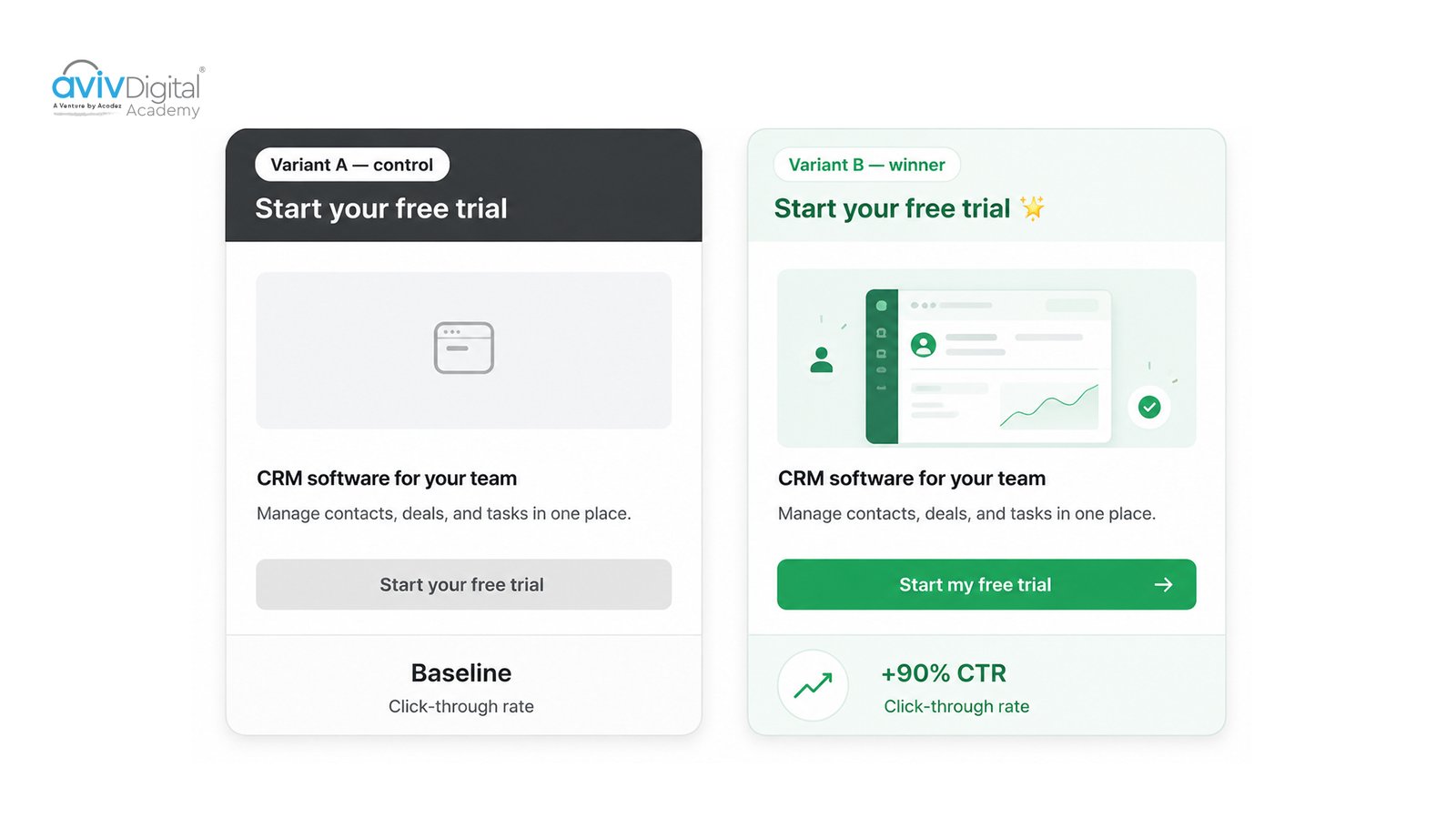
A red button communicates urgency. But “Delete Account” versus “Remove My Account Permanently” communicates entirely different levels of risk. Visual cues set tone; words set meaning. Users do not act on ambiguity; they abandon. Research by HubSpot found that changing a CTA from “Start your free trial” to “Start my free trial” increased click-through rates by 90%. One word changed. One pronoun shifted ownership to the user. The design stayed identical.
Microcopy Directly Influences Conversion
Microcopy, the small instructional text next to form fields, below CTAs, and inside error messages, is a high-leverage conversion tool. A study by Conversion Rate Experts showed that adding a single sentence of reassurance below a signup button (“We respect your privacy. Unsubscribe at any time.”) increased conversions by 19.47%. The design did not change. The microcopy did. Aviv Digital’s work with clients across Kerala and beyond consistently shows that optimising microcopy on landing pages is one of the fastest routes to measurable conversion improvement, often faster than a full design overhaul.
Error Messages Are a Trust Signal
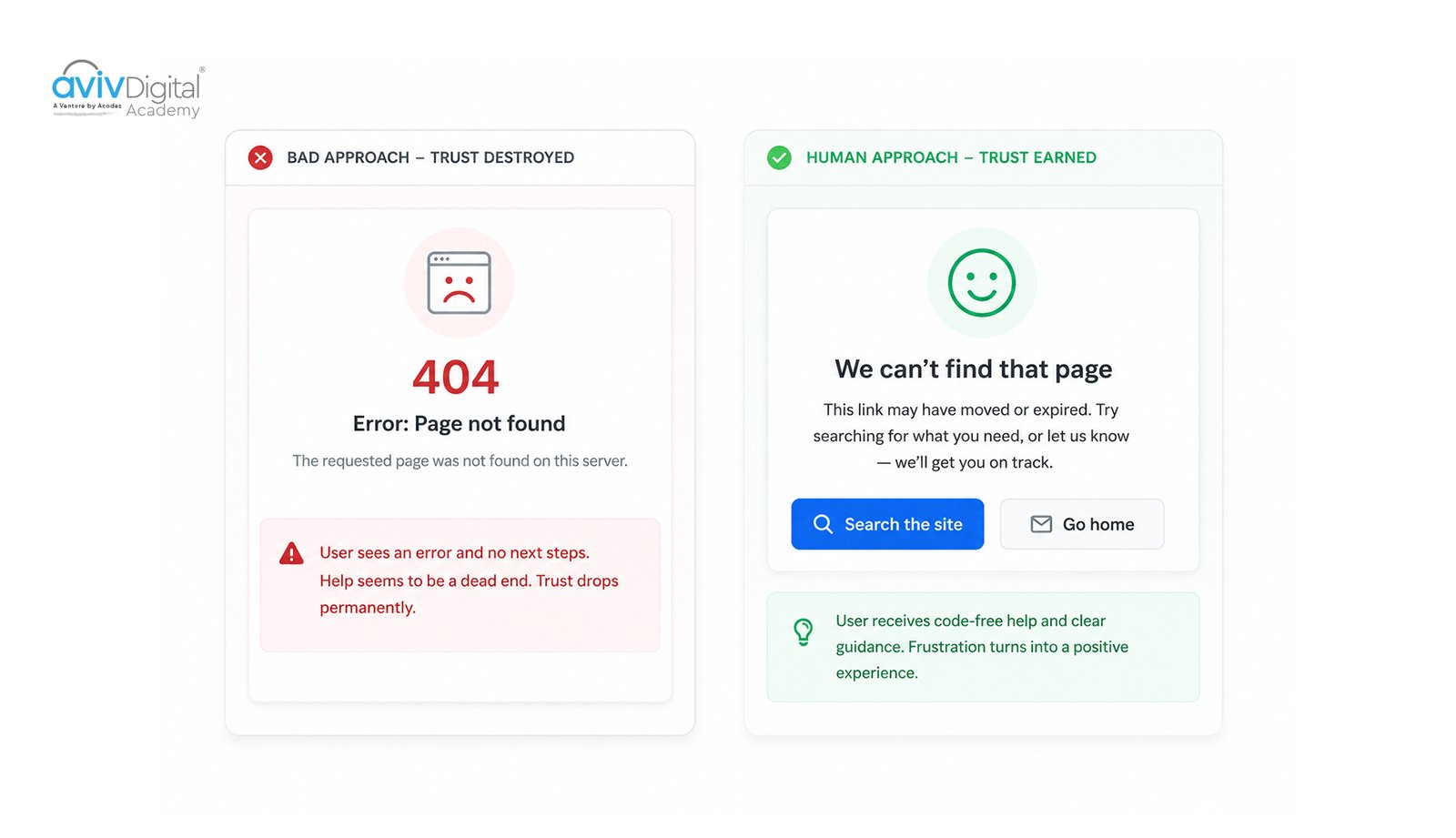
When something goes wrong, users look at words for an explanation. A generic “Error 404” destroys trust. A human message, “We cannot find that page. Try searching for what you need, or head back home,”, rebuilds it. Google’s Material Design guidelines explicitly instruct designers to treat error messages as a content design responsibility, not a developer fallback. The reason: tone in failure moments determines whether a user tries again or leaves forever.
Inclusive Language Is Part of Accessible Design
Accessibility is not only about screen readers and colour contrast. It is also about language clarity. Plain, direct language ensures that users with lower literacy levels, cognitive differences, or non-native English proficiency can still navigate your product successfully. The Web Content Accessibility Guidelines (WCAG 2.1) recommend writing at a reading level accessible to a broad audience. UX writers operationalise this standard inside every interface text decision.
Voice and Tone Define Brand Perception
Mailchimp, Slack, and Duolingo are recognisable not only by their logos but by how they speak. Their UX copy is consistent, distinct, and deliberately crafted to make users feel a specific way. That consistency is a brand moat, built word by word across hundreds of interface touchpoints.
Core Principles of Effective UX Writing
Be Clear Before You Are Clever
Wit is a bonus. Clarity is the baseline. If users have to pause to interpret a label, the label has failed. Write for the user’s fastest path to understanding, not for the writer’s enjoyment.
Use Action-Oriented Language
Every button, link, and CTA should tell users exactly what will happen when they click. “Next” tells users almost nothing. “Review Your Order” tells them exactly where they are in the journey.
Write in the User’s Voice, Not the Brand’s
Users think in terms of their own goals: “I want to send money,” not “Initiate a funds transfer.” Match your interface language to how users naturally describe their tasks.
Reduce Cognitive Load
The brain processes decisions sequentially. Long explanations, legal-style disclaimers embedded in forms, and jargon-heavy instructions all add cognitive weight. Write the minimum words needed to communicate the maximum meaning.
Test Your Copy Like You Test Your Design
A/B test CTAs. Run usability sessions and listen for hesitation. Track where users drop off in multi-step flows. UX writing is not intuition , it is iteration backed by evidence.
UX Writing vs. Content Writing vs. Copywriting
UX writing borrows from both worlds but serves a distinct master: the interface itself.
| Dimension | UX Writing | Content Writing | Copywriting |
| Primary goal | Guide users through a UI | Educate or inform | Persuade to act |
| Typical output | Labels, error messages, tooltips | Blog posts, guides, whitepapers | Ads, sales pages, emails |
| Tone | Clear, functional, empathetic | Informative, authoritative | Compelling, persuasive |
| Success metric | Task completion rate, error rate | Traffic, time on page | Conversion rate, ROAS |
Real-World UX Writing That Changed Products
- Airbnb: rewrote its onboarding empty states from “No listings yet” to “Discover places people love” , framing the blank state as an invitation rather than a failure. Engagement with the onboarding flow improved measurably.
- Google Maps: replaced “You have arrived at your destination” with “You have arrived.” Shorter. Warmer. More human. The two-word edit shipped globally as a deliberate UX writing decision.

How to Become a UX Writer
There is no single accredited path into UX writing, which is part of why the field has grown so quickly. Most working UX writers arrived from adjacent disciplines: journalism, marketing, content strategy, UX design, technical writing, or product management. The 2025 median global salary for UX writers and content designers sits at $110,000 USD, according to UX Content Collective. The median UX writer salary for 2024 is $100,000, and while UX writer job titles have shifted, demand for the skill set continues to rise. A practical roadmap looks roughly like this:
- Learn the fundamentals of UX: Read Don Norman’s The Design of Everyday Things, Steve Krug’s Don’t Make Me Think, and Torrey Podmajersky’s Strategic Writing for UX. You do not need to ship a Figma file, but you do need to think like someone who has.
- Audit interfaces you already use: Pick three apps on your phone and screenshot every screen. Rewrite the copy as if you owned the product. Note where the original copy is vague, where it is brand-first instead of user-first, and where you would have made different choices. This is the cheapest training exercise in the field.
- Build a portfolio of rewrites and case studies: Hiring managers want to see thinking, not just polished output. Show the before, the after, and the reasoning. Three strong case studies beat thirty examples without context.
- Learn the tools UX teams use day to day: Figma is the baseline. Familiarity with content management systems, basic Jira workflows, and design-handoff tools like Zeplin will shorten your ramp at any product company.
- Practice writing with constraints:. A button has 20 characters. A toast message has one line. Train yourself to cut, then cut again. Tight constraints are where UX writing skill becomes visible.
- Get into the room early: Volunteer to rewrite onboarding flows at your current job, even if it is not your title. Pair with a designer or PM and ship a small change. Reputation in this field is built case by case, not credential by credential.
Entry-level UX writer roles are still relatively rare; many people start by carrying UX writing inside a broader content design, content marketing, or product design title. Treat the first two years as a craft apprenticeship rather than a job-title hunt.
Do You Have to Be a UI/UX Designer to Be a UX Writer?
No, and most working UX writers are not trained designers. The two roles overlap but answer different questions. A UI/UX designer decides how an interface looks and behaves; a UX writer decides what it says. The collaboration is close, but the skill sets are distinct.
What a UX writer does need is design literacy. That means:
- Reading a wireframe or Figma file fluently and understanding why a flow is structured the way it is.
- Recognising standard UI patterns , modals, drawers, toasts, banners , and knowing the conventions for each.
- Thinking in user flows, not just screens. A button label that works in isolation can be wrong in the context of the three screens that lead up to it.
- Speaking the language of designers and engineers well enough to push back when copy is being squeezed into a layout that does not serve it.
You do not need to design the screen. You do need to read the screen, understand the constraints, and propose copy that respects them. Many of the strongest UX writers come from editorial backgrounds and pick up design literacy on the job , usually within a few months of pairing closely with a product team.
Can a Content Writer Become a UX Writer?
Yes, and it is one of the most common transitions in the field. Content writers already have most of the foundation: an ear for voice, comfort with editing, and the discipline of writing to a brief. The shift from content writing to UX writing is largely a shift in mindset and constraint, not raw craft.
Three differences are worth naming honestly:
- Length: Content writers usually expand; UX writers usually compress. The instinct to add a vivid example or a transitional sentence has to be retrained. A great UX writer can convey in five words what a blog post would take a paragraph to say.
- Audience context. A blog reader chose to be reading. A user reading microcopy is mid-task and slightly irritated that they have to read at all. UX copy is written for people who would rather not be reading it. That changes everything about tone and structure.
- Collaboration. Content writing is often solo work; UX writing is always team sport. You are working alongside designers, PMs, researchers, and engineers , sometimes inside the same Figma file, sometimes inside the same hour. Comfort with iteration and critique is non-negotiable.
For content writers looking to make the move, the fastest path is volunteering to rewrite microcopy at their current job, taking a course like UX Writing Hub’s certification programme, and building two or three case studies that demonstrate before-and-after thinking. Within six to twelve months of focused practice, most strong content writers can hold their own in a junior UX writing role.
How to Build a UX Writing Practice
- Audit your current interface copy: Screenshot every screen in your product and read every word. Identify anything vague, jargon-heavy, or tone-inconsistent.
- Create a voice and tone guide: Define 3–5 adjectives that describe your brand voice. Map them to specific interface scenarios (errors, celebrations, empty states).
- Establish a UX copy review step: Make copy review a mandatory step before any design goes to development , not after.
- Collaborate across teams: UX writers should work alongside product designers, researchers, and developers from the discovery phase, not the polish phase.
- Measure what matters: Track task completion rates, error message dismissal rates, and form abandon rates as leading indicators of UX writing quality.
Conclusion
UX writing is not a soft skill sitting at the edge of product development. It is a core design discipline. When the words and the visuals work in harmony , when every label, error message, and CTA is as deliberate as the typography and colour palette , the result is an experience users trust, return to, and recommend. For brands building a strong digital presence, investing in UX writing is not optional. It is one of the highest-leverage moves available.
Aviv Digital Academy is one of the leading UI UX Design Course in Calicut. We offer a comprehensive curriculum designed to equip you with the skills and knowledge necessary to thrive in the design industry. Our programs provide a comprehensive Guide to become a UI/UX Designer. For more details, contact us at: +91 8156998844
Frequently Asked Questions
What does a UX writer do?
A UX writer crafts the words inside digital products , buttons, error messages, onboarding flows, tooltips, and navigation labels. Their goal is to help users complete tasks efficiently and confidently while reinforcing the brand’s voice.
Is UX writing the same as content writing?
No. Content writing creates long-form educational or marketing material (blogs, guides, articles). UX writing creates short, functional interface copy. Both require strong writing skills, but they serve different goals and contexts.
How much does UX writing affect conversion rates?
Significantly. Small copy changes , a single word in a CTA, one sentence of reassurance below a form field , can shift conversion rates by 10–90% depending on the context and how well the original copy was performing.
Do small businesses need a UX writer?
Not necessarily a full-time hire, but every business with a digital product benefits from applying UX writing principles. A content strategist, a UX-aware marketer, or even a short audit with a freelance UX writer can surface high-value copy changes quickly.
What is microcopy in UX writing?
Microcopy is the small but powerful text found throughout an interface: the hint text inside a search bar, the label beneath a password field, the confirmation message after a form submission. Microcopy has an outsized impact on user trust and task completion relative to its word count.